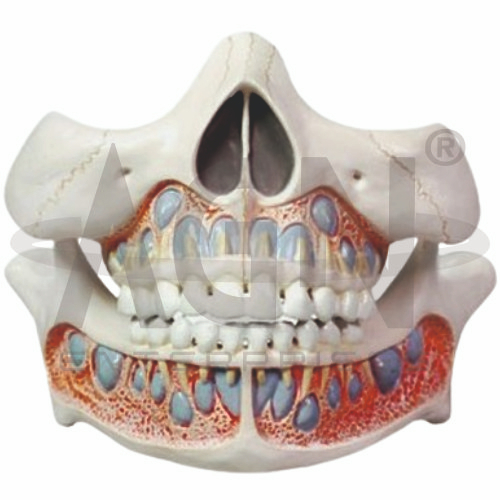
The Deciduous Teeth Model Life Size from AGN Enterprises is an anatomical dental teaching aid designed to demonstrate the natural arrangement, morphology, and position of primary teeth in life-size form. Also known as milk teeth or primary teeth, deciduous teeth form the first dentition in children.
The model provides students with a three-dimensional reference for studying primary incisors, canines, and molars and their arrangement within the dental arches. It is suitable for dental colleges, medical colleges, nursing institutes, dental hygiene programs, pediatric dentistry departments, schools, and oral-health education centers.
The Deciduous Teeth Model Life Size represents the primary human dentition in approximately natural anatomical dimensions.
Depending on the specific model configuration, represented structures may include:
Central Incisors
Lateral Incisors
Canines
First Molars
Second Molars
Upper Dental Arch
Lower Dental Arch
Crowns
Roots
The exact construction, mounting, articulation, colors, and anatomical details may vary according to the supplied model.
Humans normally develop 20 deciduous teeth, consisting of 10 teeth in the maxillary arch and 10 in the mandibular arch.
Each quadrant normally contains:
2 Incisors
1 Canine
2 Molars
The model helps students identify these tooth types and understand their arrangement within the primary dentition.
Primary incisors are positioned in the anterior region of the dental arches.
They include the central and lateral incisors and are primarily adapted for biting and cutting food.
The life-size model provides a useful reference for comparing their morphology and positions.
The deciduous canines are positioned between the lateral incisors and first primary molars.
Their pointed crowns contribute to gripping and tearing food.
The model helps students study the position and morphology of primary canines within both dental arches.
Each quadrant of the primary dentition contains a first and second molar.
Primary molars have broader occlusal surfaces suited to crushing and grinding food. They also play an important role in maintaining space for developing permanent teeth.
The model helps learners distinguish primary molars from incisors and canines.
The life-size design provides a realistic reference for studying the approximate dimensions and arrangement of deciduous teeth.
Unlike highly enlarged dental models, a life-size model helps students appreciate tooth proportions and relationships closer to their natural anatomical scale.
This makes it useful for practical dental anatomy demonstrations.
Deciduous teeth are gradually replaced by permanent teeth during normal dental development.
Studying the primary dentition helps students understand tooth eruption, exfoliation, mixed dentition, occlusal development, and the transition to permanent dentition.
The model can be used alongside a permanent-teeth model for comparative teaching.
Primary teeth contribute to several important functions, including:
The model provides a useful visual aid for explaining these functions during pediatric dental education.
The Deciduous Teeth Model Life Size is particularly useful for pediatric dentistry and oral-health teaching.
It can support demonstrations involving primary tooth identification, dental morphology, eruption patterns, oral hygiene, tooth decay prevention, and differences between primary and permanent dentition.
It may also be used as a visual aid during patient and parent education.
The model provides students with a three-dimensional approach to studying primary dental anatomy.
Teachers can use it for lessons involving deciduous teeth, primary dentition, tooth morphology, incisors, canines, molars, dental arches, pediatric dentistry, and tooth development.
It supports tooth identification, practical demonstrations, comparative anatomy, and examination preparation.
AGN Enterprises supplies dental models, anatomical teaching aids, pathological models, biological models, scientific instruments, and educational laboratory equipment for dental colleges, medical institutions, nursing programs, schools, and professional training centers.
Our educational models provide clear three-dimensional representations for practical dental and medical education.