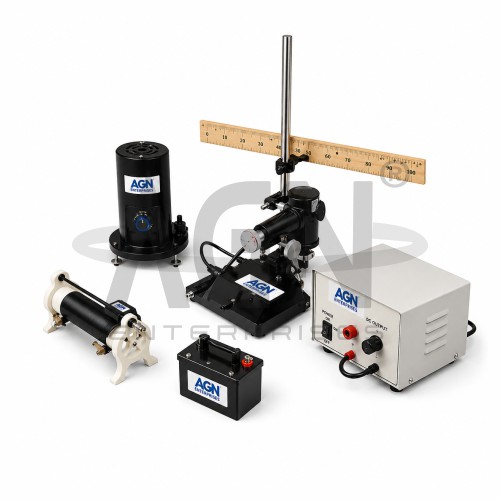
The Current Sensitivity and Ballistic Constant K of Ballistic Galvanometer apparatus from AGN Enterprises is a complete educational physics laboratory setup designed to determine the current sensitivity and ballistic constant (K) of a ballistic galvanometer.
The illustrated setup includes a ballistic galvanometer, lamp and scale arrangement, electrical resistance unit, power supply, battery, connecting accessories, and optical observation assembly. Together, these components allow students to study both the steady-current response and the transient-charge response of a ballistic galvanometer.
A ballistic galvanometer responds to a short pulse of charge with a measurable first throw. Therefore, it is useful for studying charge measurement and transient electrical phenomena.
The apparatus is suitable for undergraduate physics laboratories, colleges, universities, engineering institutes, polytechnics, and advanced electricity and magnetism practicals.
The main objectives are:
To determine the current sensitivity of a ballistic galvanometer.
To determine the ballistic constant K of the ballistic galvanometer.
Additionally, students can study the time period, steady deflection, first ballistic throw, damping, and relationship between current sensitivity and charge response.
A ballistic galvanometer is a sensitive galvanometer designed primarily to measure a quantity of electric charge passing through its coil during a short interval.
Unlike a conventional galvanometer used mainly for steady-current indication, a ballistic galvanometer has a relatively long oscillation period. Consequently, a short electrical impulse produces a measurable first throw related to the total charge passing through the coil.
When a steady current flows through the galvanometer coil, the magnetic field produces a deflecting torque.
For equilibrium:
NABI = Cθ
where:
N = Number of turns of the coil
A = Area of the coil
B = Magnetic flux density
I = Current
C = Restoring couple per unit angular twist
θ = Steady angular deflection
Therefore, the steady deflection provides a method for determining the galvanometer’s current sensitivity.
The current sensitivity of a moving-coil ballistic galvanometer is commonly defined as the steady deflection produced per unit current:
Sᵢ = θ / I
where:
Sᵢ = Current sensitivity
θ = Steady deflection
I = Current through the galvanometer
Thus, a galvanometer with greater current sensitivity produces a larger deflection for the same current.
Some laboratory manuals use the reciprocal quantity, I/θ, as the figure of merit. Therefore, students should follow the convention specified in their prescribed experiment.
When a short pulse of charge passes through the ballistic galvanometer, the first maximum throw is proportional to the total charge.
The relationship is:
q = Kθₘ
Therefore:
K = q / θₘ
where:
K = Ballistic constant
q = Charge passing through the galvanometer
θₘ = Maximum ballistic throw
Thus, the ballistic constant represents the charge corresponding to unit ballistic deflection.
For an ideal moving-coil ballistic galvanometer:
K = (C/NAB)(T/2π)
where:
T = Time period of the moving system
Therefore:
q = Kθₘ
This equation connects the mechanical properties of the galvanometer with its electrical response to a short charge impulse.
Since:
I/θ = C/NAB
and:
K = (C/NAB)(T/2π)
we obtain:
K = (T/2π)(I/θ)
under the corresponding ideal conditions and angular-deflection convention.
Therefore, students can connect the steady-current behavior of the galvanometer with its ballistic response.
The illustrated setup includes a lamp and scale arrangement for observing small galvanometer deflections.
A beam of light falls on the mirror associated with the galvanometer. The reflected light reaches a graduated scale, and movement of the galvanometer system causes the light spot to move along the scale.
This optical method magnifies small angular movements and allows students to record deflections conveniently.
The horizontal graduated scale provides a reference for observing both steady deflections and ballistic throws.
Students should position and align the scale correctly before starting measurements. Furthermore, the optical system should produce a clear and sharply defined light spot or reference image.
First, students connect the galvanometer in the prescribed steady-current circuit.
Next, they pass a small known current through the galvanometer and record the corresponding steady deflection.
They can then calculate:
Current Sensitivity = Deflection / Current
Repeating the measurement for several small currents can improve experimental reliability.
The time period forms an important part of the ballistic constant calculation.
Students allow the galvanometer to oscillate and measure the total time for several complete oscillations.
They can then calculate:
T = Total Time / Number of Oscillations
Measuring several oscillations rather than only one generally reduces timing uncertainty.
After determining the required steady-current parameters and time period, students calculate the ballistic constant using the prescribed experimental relationship.
Alternatively, a known capacitor can provide a known charge. If a capacitor of capacitance C₁ is charged to voltage V, then:
q = C₁V
After discharge through the ballistic galvanometer:
K = C₁V / θₘ
where θₘ represents the appropriate ballistic throw.
The first throw is the initial maximum displacement produced after a short quantity of charge passes through the galvanometer.
Students should record this value carefully because the ballistic constant depends directly on it.
Moreover, repeated observations allow students to calculate an average value and improve experimental consistency.
A real ballistic galvanometer experiences damping due to mechanical resistance, air resistance, and electromagnetic effects.
As a result, successive oscillations gradually decrease in amplitude.
For experiments requiring greater accuracy, students can determine the damping behavior and apply the appropriate correction to the observed first throw.
The shown experimental arrangement includes:
Exact resistance ranges, supply voltage, galvanometer specifications, scale dimensions, and other technical parameters may vary according to the supplied model.
Students can use this setup to:
The experiment helps students understand:
Current Sensitivity
Ballistic Constant
Electric Charge
Steady Current
Ballistic Deflection
Time Period
Damping
Moving-Coil Galvanometer
Transient Electrical Response
Precision Measurement
Furthermore, students learn the important difference between the response of a galvanometer to steady current and its response to a short electrical impulse.
The apparatus provides practical training in electricity, magnetism, electrical measurement, galvanometer theory, oscillations, and transient phenomena.
After students understand and calibrate the ballistic galvanometer, they can apply the same principles to other suitable experiments involving charge and changes in magnetic flux.
Students should use only small currents within the specified operating range of the galvanometer.
Moreover, they should protect the galvanometer from vibration and mechanical shock. The optical scale should remain stable during observations.
Students should allow the galvanometer to settle before taking a new reading and should avoid excessive deflection of the moving system.
Users should handle the ballistic galvanometer carefully because it contains a sensitive moving mechanism.
They should keep the optical components, scale, terminals, and connecting leads clean. Furthermore, users should protect the equipment from excessive moisture, dust, vibration, and impact.
After completing the experiment, users should switch off the electrical supply and store the apparatus safely.
The Current Sensitivity and Ballistic Constant K of Ballistic Galvanometer apparatus is suitable for:
AGN Enterprises supplies ballistic galvanometers, galvanometer experimental setups, electrical measurement equipment, optical scale arrangements, resistance apparatus, and advanced physics laboratory instruments.
Furthermore, our educational equipment supports undergraduate practical work, electrical measurement, engineering education, physics demonstrations, and scientific laboratory training.