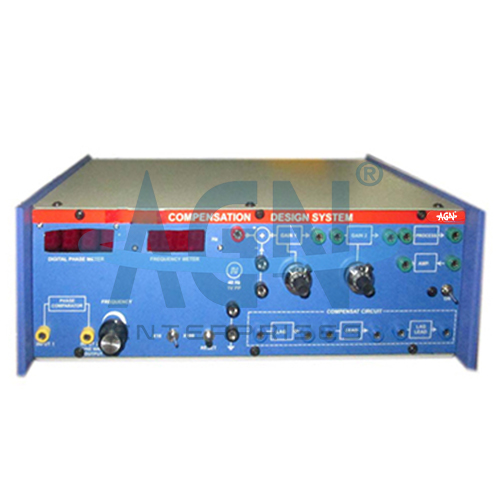
The Compensation Design System from AGN Enterprises is an educational control engineering trainer designed for the practical study of compensators, system response, stability improvement, transient characteristics, and feedback control principles. It enables students to understand how compensation techniques modify the performance of a control system to achieve desired operating characteristics.
In practical control systems, the uncompensated response may not satisfy required specifications for stability, accuracy, speed, or transient performance. Therefore, engineers introduce suitable compensating networks to modify system behavior. The trainer provides a convenient experimental platform for investigating these important concepts through practical measurements and response analysis.
Students can study lead compensation, lag compensation, and lead-lag compensation according to the supplied experimental configuration. Moreover, learners can examine how compensation influences parameters such as response time, steady-state accuracy, stability, phase characteristics, and overall system performance.
The system helps students connect mathematical control theory with actual circuit behavior. Consequently, they can compare compensated and uncompensated responses, record experimental observations, analyze characteristic changes, and understand the purpose of selecting an appropriate compensator. Furthermore, the trainer supports the study of feedback loops, transfer functions, frequency-response concepts, and controller design fundamentals.
For additional educational information about control systems and automation technologies, students can refer to IEEE.
The Compensation Design System provides a structured platform for demonstrating the effect of compensation on dynamic control-system performance. In addition, instructors can use the trainer to explain how different compensating networks modify system characteristics and help meet specified control requirements.