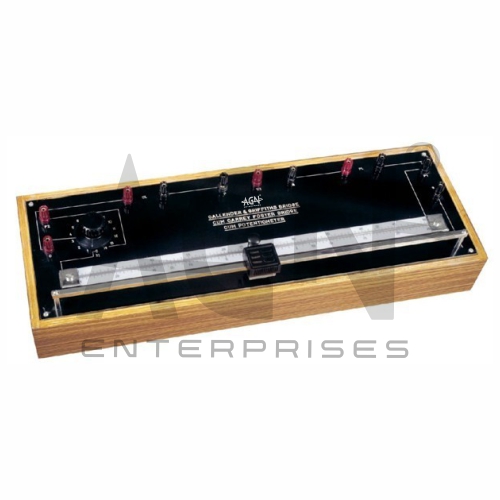
The Callendar and Griffiths Bridge from AGN Enterprises is a precision physics laboratory apparatus for studying electrical resistance, resistance variation with temperature, and platinum resistance thermometry. The instrument uses the bridge balance principle to help students measure small resistance changes accurately.
The apparatus features a long graduated bridge scale, sliding contact arrangement, electrical terminals, control components, and a robust wooden enclosure. Its clear layout makes it suitable for advanced physics practicals and classroom demonstrations.
Moreover, the apparatus connects electrical measurement with thermal physics. Students can investigate how the resistance of a metallic conductor changes as its temperature changes.
The Callendar and Griffiths Bridge is suitable for colleges, universities, engineering institutes, polytechnics, physics departments, teacher-training institutions, and advanced science laboratories.
The Callendar and Griffiths Bridge operates using a bridge or null-measurement principle.
An unknown or temperature-dependent resistance is compared with known electrical resistance values. The sliding contact is adjusted until a balance condition is obtained, typically indicated using a suitable null detector or galvanometer.
At balance, the relevant bridge relationship can be used to determine the resistance under investigation.
The Callendar and Griffiths Bridge is suitable for:
The graduated scale, sliding contact, electrical terminals, and resistance connections should be kept clean and free from corrosion.
The sliding mechanism should move smoothly without excessive force. Electrical contacts should be periodically inspected to ensure reliable connections.
The wooden enclosure should be protected from excessive moisture, heat, and chemical spills.
AGN Enterprises supplies Callendar and Griffiths Bridges, Wheatstone bridges, meter bridges, resistance boxes, galvanometers, potentiometers, thermal physics apparatus, and precision electrical measuring equipment for colleges, universities, engineering institutes, polytechnics, and scientific laboratories.
Our physics laboratory equipment supports practical experimentation, electrical measurement, thermal studies, engineering education, and advanced scientific training.