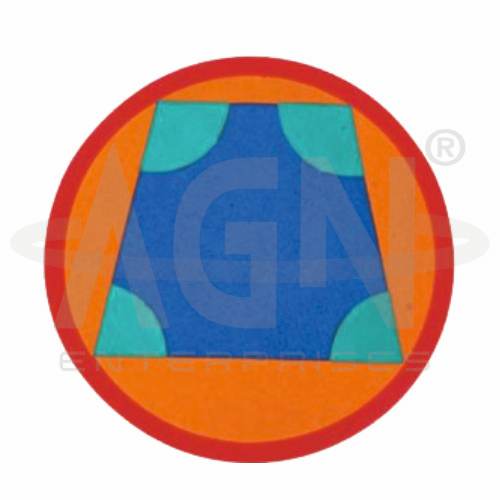
The Angle Property of Cyclic Quadrilateral from AGN Enterprises is a hands-on mathematics teaching model designed to demonstrate an important theorem of circle geometry: the opposite angles of a cyclic quadrilateral are supplementary. The model provides a visual and practical way for students to understand the relationship between a quadrilateral and its circumscribed circle, making geometrical theorem learning easier and more engaging. It is suitable for middle and secondary schools, mathematics laboratories, teacher training institutes, STEM classrooms, and activity-based learning programs.
A cyclic quadrilateral is a quadrilateral whose four vertices lie on the circumference of the same circle.
If ABCD is a cyclic quadrilateral, then its opposite angles satisfy:
∠A + ∠C = 180°
and
∠B + ∠D = 180°
Therefore, each pair of opposite angles is supplementary.
The model helps students visualize this relationship and understand the theorem through direct observation.
Suppose one angle of a cyclic quadrilateral is:
∠A = 110°
Since its opposite angle ∠C is supplementary:
∠A + ∠C = 180°
Therefore:
∠C = 180° − 110°
∠C = 70°
Similarly, if:
∠B = 95°
then:
∠D = 180° − 95° = 85°
Hence:
110° + 70° = 180°
and
95° + 85° = 180°
The model allows teachers to connect these numerical calculations with a clear geometrical representation.
The Angle Property of Cyclic Quadrilateral model can help students understand several related terms and concepts:
Circle – the curve on which all four vertices of the cyclic quadrilateral lie.
Quadrilateral – a polygon having four sides and four vertices.
Opposite Angles – angles located at opposite vertices of the quadrilateral.
Supplementary Angles – two angles whose measures add up to 180°.
These concepts provide a foundation for studying more advanced circle theorems.
The Angle Property of Cyclic Quadrilateral converts an abstract geometry theorem into a visual classroom demonstration. Students can observe the quadrilateral inside a circle and investigate how changes in its shape affect its angles while the supplementary relationship remains valid.
Teachers can use the model for lessons involving cyclic quadrilaterals, circle theorems, supplementary angles, interior angles, geometrical proofs, and missing-angle calculations.
Hands-on demonstrations help develop geometrical reasoning, theorem understanding, spatial visualization, logical thinking, and problem-solving skills.
AGN Enterprises supplies mathematics teaching aids and theorem models designed to promote practical, visual, and activity-based education. Our geometry models help teachers demonstrate mathematical properties clearly while encouraging students to understand the reasoning behind geometrical theorems.
We also provide competitive pricing, institutional and bulk supply, prompt delivery, and support for mathematics laboratory requirements.