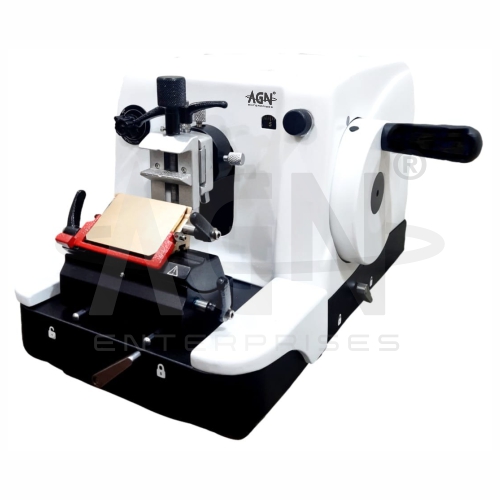
The Advance Rotary Microtome Manual from AGN Enterprises is a precision laboratory instrument designed for producing thin and consistent sections of tissue specimens for microscopic examination. Its manually operated rotary mechanism provides controlled specimen advancement and sectioning, making it suitable for routine histology, pathology, biology, and research laboratory applications.
The instrument is suitable for medical colleges, pathology laboratories, histology laboratories, hospitals, research institutions, universities, veterinary laboratories, and biomedical training centers.
A rotary microtome is used to cut embedded biological specimens into thin sections that can subsequently be prepared for microscopic examination.
The manual rotary mechanism allows the operator to control the sectioning cycle using the handwheel. Properly prepared and embedded specimens can be advanced toward the cutting blade in controlled increments.
The exact section-thickness range, specimen-feed mechanism, blade compatibility, and technical specifications depend on the supplied model.
The Advance Rotary Microtome Manual is designed to support controlled sectioning of properly prepared specimens.
Consistent section thickness is important in histological preparation because thin sections allow light to pass through appropriately prepared tissue for microscopic observation.
Actual section quality depends on factors including specimen preparation, embedding medium, blade condition, thickness setting, and operator technique.
The prominent handwheel provides manual control over the sectioning movement.
Rotating the handwheel moves the specimen through a controlled cutting cycle, giving the operator direct control during section preparation.
Manual operation makes the instrument useful for routine laboratory work as well as teaching students the fundamental principles of microtomy.
The specimen-holding assembly is designed to secure an appropriately prepared specimen during sectioning.
Correct positioning and firm clamping are important for obtaining uniform sections. The adjustable arrangement allows the specimen to be aligned with the cutting system before operation.
Specific holder design and supported specimen dimensions may vary according to the supplied configuration.
The cutting assembly holds the appropriate microtome blade or knife in position during sectioning.
Proper blade alignment is essential for obtaining smooth sections and reducing common sectioning defects.
Blade type, holder design, compatibility, and included accessories should be confirmed from the technical specifications of the supplied instrument.
The Advance Rotary Microtome Manual is particularly useful in laboratories preparing tissue sections for histological study.
A typical laboratory workflow may involve:
Tissue Preparation → Processing → Embedding → Microtome Sectioning → Slide Preparation → Staining → Microscopic Examination
The microtome performs the critical sectioning stage within this workflow.
Manual rotary microtomes are useful in environments where prepared biological specimens need to be sectioned for subsequent microscopic study.
Potential applications include histology, pathology education, biomedical research, veterinary histology, biological research, and laboratory training.
Users should follow appropriate laboratory protocols and instrument-specific operating instructions.
The instrument provides students with practical exposure to the principles of microtomy and histological specimen preparation.
It can help demonstrate specimen orientation, section-thickness selection, blade positioning, manual sectioning, section collection, and preparation of samples for microscopy.
This makes it valuable for practical training in histology, pathology, medical laboratory technology, and biomedical sciences.
AGN Enterprises supplies laboratory equipment, scientific instruments, pathology equipment, histology instruments, anatomical models, and educational laboratory products for medical colleges, universities, hospitals, research laboratories, and professional institutions.
Our laboratory instruments support practical training, routine laboratory procedures, scientific research, and educational applications.