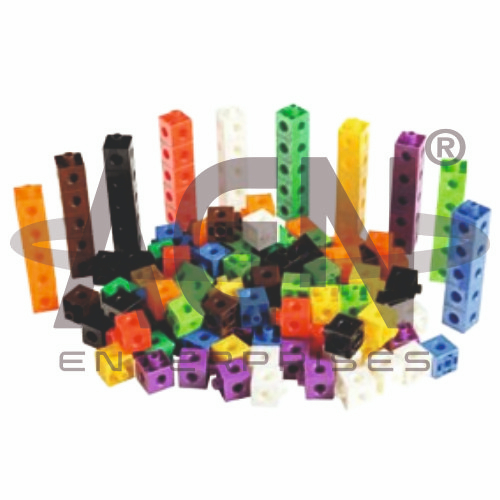
The 1cm Interlocking Cubes from AGN Enterprises are compact, hands-on mathematics manipulatives designed to help students explore counting, number operations, patterns, measurement, area, volume, fractions, ratios, and three-dimensional geometry. Each cube has an approximate edge length of 1 cm and can be connected with other cubes to form rows, arrays, patterns, and 3D structures. They are suitable for primary and middle schools, mathematics laboratories, Montessori classrooms, STEM activities, and activity-based learning programs.
The 1cm Interlocking Cubes can be joined and separated repeatedly, allowing students to physically construct mathematical models.
They can be used for:
Counting – representing quantities with individual cubes.
Addition – joining groups of cubes together.
Subtraction – removing cubes from an existing group.
Multiplication – creating equal groups or arrays.
Division – separating a quantity into equal groups.
The interlocking construction makes the cubes particularly useful for activities where students need to build, compare, and rearrange quantities.
With an approximate edge length of 1 cm, the cubes provide a convenient visual representation of centimetre-based measurement.
For example:
1 Cube Length = 1 cm
5 Cubes in a Row = 5 cm
10 Cubes in a Row = 10 cm
Students can construct cube trains and use them to compare lengths or estimate the dimensions of suitable classroom objects.
This helps connect counting with standard units of measurement.
The 1cm Interlocking Cubes are particularly useful for introducing area and volume concepts.
A face of a 1 cm cube measures:
1 cm × 1 cm = 1 cm²
The volume of one cube is:
1 cm × 1 cm × 1 cm = 1 cm³
Students can therefore construct rectangular solids and count the cubes to investigate:
Volume = Length × Breadth × Height
For example, a model measuring:
4 cm × 3 cm × 2 cm
has a volume of:
4 × 3 × 2 = 24 cm³
This provides a concrete representation of cubic units.
When different colours are included in the supplied set, students can use the cubes to create repeating patterns and investigate fractions and ratios.
For example, a train of 10 cubes containing 4 cubes of one colour can represent:
4/10 = 2/5
Different colour groups can also demonstrate simple ratios such as:
3 : 2
These activities connect number concepts with visual and spatial representations.
The 1cm Interlocking Cubes transform mathematical concepts into construction-based activities. Students can count, connect, separate, measure, compare, and build models while investigating mathematical relationships.
Teachers can use the cubes for lessons involving arithmetic, measurement, patterns, fractions, ratios, area, volume, geometry, and spatial reasoning.
Hands-on activities help develop number sense, logical reasoning, spatial visualization, fine motor coordination, creativity, and problem-solving skills.
AGN Enterprises supplies mathematics manipulatives designed to promote practical, visual, and activity-based education. Our interlocking cubes provide teachers with a flexible classroom resource that can support multiple mathematical concepts across different learning levels.
We also provide competitive pricing, institutional and bulk supply, prompt delivery, and support for mathematics laboratory requirements.