

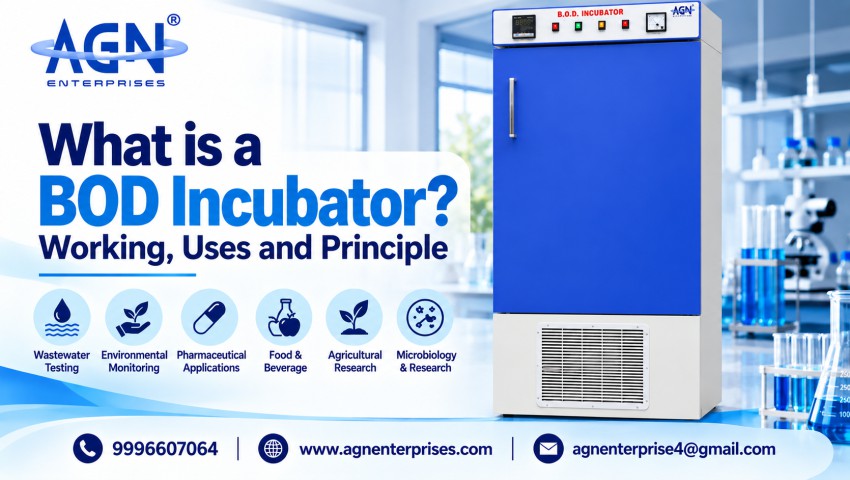
What is a BOD incubator? A BOD incubator is a temperature-controlled laboratory instrument used for biochemical oxygen demand (BOD) testing, environmental analysis, microbiological research, pharmaceutical applications, food testing, agricultural studies, and other controlled-temperature experiments.
For laboratories that perform BOD testing or other temperature-sensitive experiments, accurate temperature control is essential. Therefore, users should consider temperature range, chamber capacity, temperature uniformity, construction, refrigeration performance, and maintenance requirements before purchasing a BOD incubator.
A BOD incubator maintains a stable and controlled temperature inside its chamber for extended laboratory applications. The instrument combines a heating system, refrigeration system, temperature sensor, digital controller, insulation, and air circulation system.
In particular, laboratories use BOD incubators for applications that require controlled temperatures below normal room temperature. For example, environmental laboratories commonly use them during BOD testing of water and wastewater samples.
Moreover, pharmaceutical, food, agricultural, microbiological, biotechnology, and research laboratories can use BOD incubators for various controlled-temperature applications.

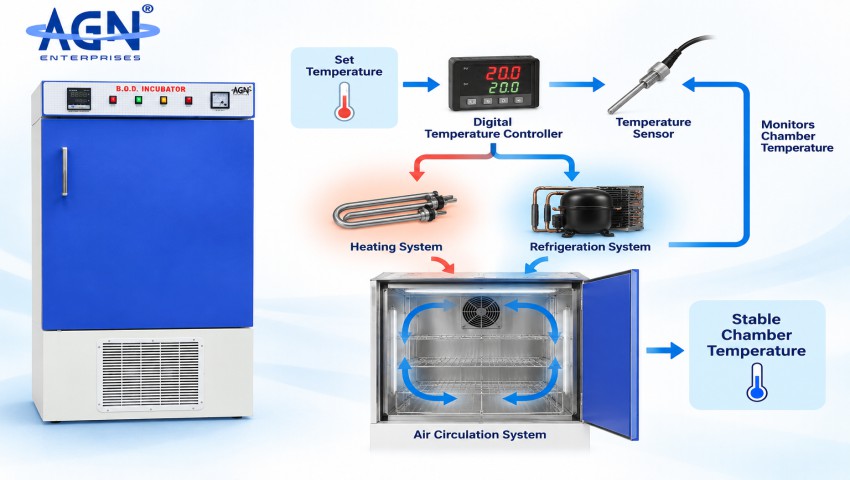 The BOD incubator working principle relies on continuous temperature measurement and automatic heating or cooling.
First, the operator sets the required temperature through the digital controller. Next, the temperature sensor continuously measures the chamber temperature. The controller then compares the measured temperature with the selected set point.
If the chamber temperature falls below the required level, the heating system increases the temperature. Conversely, if the temperature rises above the selected level, the refrigeration system starts cooling the chamber.
At the same time, the air circulation system distributes conditioned air throughout the chamber. As a result, the incubator can maintain a more uniform temperature around the samples.
Therefore, the combination of heating, cooling, sensing, and electronic control allows a BOD incubator to maintain stable conditions for long-duration laboratory experiments.
A BOD incubator contains several important components. Each component performs a specific function to maintain controlled incubation conditions.
The inner chamber provides space for samples and helps maintain the selected temperature. Furthermore, proper insulation reduces heat exchange with the surrounding laboratory environment.
The temperature sensor continuously measures the chamber temperature. It then sends the measurement to the digital controller for automatic regulation.
The digital controller allows the operator to set and monitor the required temperature. Additionally, advanced controllers can provide precise temperature regulation during long-duration operation.
The refrigeration system allows the incubator to operate below ambient temperature. Therefore, it plays an important role in BOD testing and other low-temperature laboratory applications.
The heating element increases the chamber temperature whenever the measured temperature falls below the selected set point.
The circulation system distributes conditioned air inside the chamber. Consequently, it helps reduce temperature differences between different shelf positions.
Adjustable shelves allow laboratory personnel to organize samples according to their size and quantity. In addition, removable shelves can make chamber cleaning easier.
Temperature plays a critical role in BOD testing and other controlled-temperature laboratory applications.
A BOD incubator can offer a wider operating range depending on its model and design. However, users should distinguish between the temperature range of the equipment and the temperature required by a particular testing method.
For standard BOD testing, laboratories commonly use controlled incubation around 20°C. Nevertheless, users should always follow the applicable testing method, standard, or laboratory protocol when determining the exact operating temperature.
When selecting a BOD incubator, check the following parameters:
As a result, laboratories can select an instrument that matches their actual testing requirements.
BOD incubator specifications vary according to the model, capacity, and application. Therefore, buyers should compare the following parameters before making a purchase.
| Specification | Importance |
|---|---|
| Temperature range | Determines available operating conditions |
| Temperature accuracy | Helps maintain the required test temperature |
| Chamber capacity | Determines the quantity of samples the chamber can accommodate |
| Digital controller | Allows easy temperature setting and monitoring |
| Refrigeration system | Enables operation below ambient temperature |
| Heating system | Supports temperature adjustment |
| Air circulation | Helps maintain temperature uniformity |
| Insulation | Reduces external temperature influence |
| Shelving | Improves sample organization |
| Chamber construction | Supports durability and laboratory use |
Additionally, laboratories should consider their sample volume and workload instead of choosing an incubator based only on chamber size.
BOD incubators support a wide range of laboratory applications because they provide stable and controlled temperature conditions.

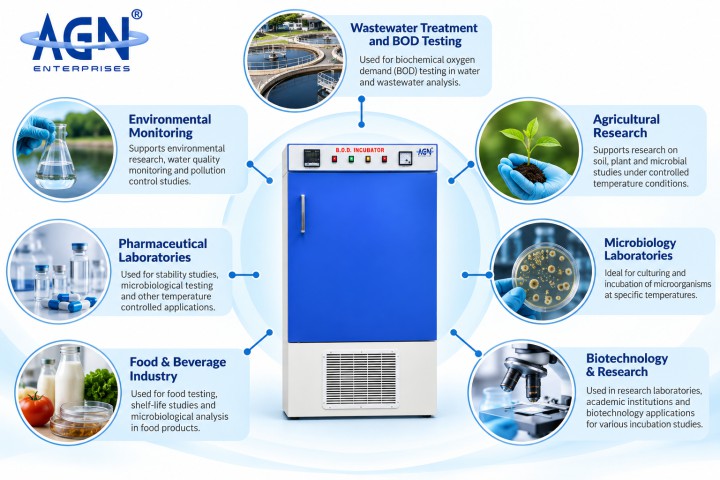 1. Wastewater Treatment and BOD Testing
One of the primary BOD incubator uses involves biochemical oxygen demand testing. Environmental laboratories use controlled incubation conditions while analyzing water and wastewater samples.
BOD testing helps determine the amount of dissolved oxygen that microorganisms consume while breaking down organic matter in a water sample.
Therefore, accurate temperature control plays an important role in obtaining reliable BOD test results.
Environmental laboratories use BOD incubators for controlled-temperature testing related to water quality and pollution studies.
For example, laboratories can use controlled incubation conditions when evaluating water samples from different environmental sources. Consequently, BOD incubators support environmental monitoring and laboratory analysis.
Microbiological laboratories can use BOD incubators for selected experiments that require stable temperatures below normal ambient conditions.
Moreover, the controlled environment allows researchers to maintain consistent experimental conditions for extended periods.
Pharmaceutical laboratories may use BOD incubators for selected temperature-controlled studies and research applications.
In addition, laboratories can select suitable temperature ranges and chamber capacities according to their specific testing requirements.
Food and beverage laboratories use temperature-controlled equipment for various quality-control and microbiological applications.
Therefore, a BOD incubator can support selected laboratory procedures that require controlled temperatures and stable environmental conditions.
Agricultural and research laboratories can use controlled-temperature incubators for selected studies involving seeds, plant materials, soil samples, and biological processes.
Furthermore, stable temperature conditions help researchers maintain consistent experimental parameters.
Biotechnology and research laboratories may require controlled temperatures for long-duration experiments. In such cases, a BOD incubator can provide a stable chamber environment for suitable applications.
Although both instruments provide controlled incubation conditions, they serve different laboratory requirements.
| Feature | BOD Incubator | Bacteriological Incubator |
|---|---|---|
| Heating | Yes | Yes |
| Cooling | Yes | Generally no dedicated refrigeration |
| Below-ambient operation | Yes, depending on model | Usually limited |
| BOD testing | Suitable | Not the primary application |
| Temperature control | Heating and cooling | Primarily heating |
| Typical applications | BOD, environmental and controlled-temperature studies | Microbiological culture and incubation |
Therefore, laboratories that require temperatures below ambient conditions should generally consider a BOD incubator instead of a basic heating incubator.
A BOD incubator provides several advantages for laboratories that require controlled temperatures.
The digital controller helps users select and monitor the required chamber temperature.
Unlike a basic heating incubator, a BOD incubator can combine heating and refrigeration. Therefore, it can support low-temperature applications.
The insulation and air circulation system help maintain stable conditions throughout the chamber.
Laboratories can use BOD incubators for experiments that require controlled temperatures over extended periods.
Furthermore, laboratories across environmental, pharmaceutical, food, agricultural, microbiological, and research sectors can use suitable BOD incubators.
Despite these benefits, users should also consider several limitations.
First, refrigeration systems require regular maintenance. In addition, cooling operation can increase energy consumption.
Moreover, BOD incubators generally cost more than basic heating-only incubators because they incorporate additional cooling components.
The laboratory must also select an appropriate chamber capacity. An oversized unit may increase operating costs, while an undersized chamber may not accommodate the required sample load.
Finally, laboratories should periodically verify temperature performance and follow an appropriate calibration and maintenance schedule.
Regular maintenance helps laboratories maintain reliable temperature performance and extend equipment life.
Clean the chamber and remove spills or contamination according to appropriate laboratory procedures. In addition, keep shelves clean and organized.
Periodically compare the displayed temperature with a calibrated reference instrument. This practice helps identify temperature deviations at an early stage.
Keep ventilation areas clean and free from unnecessary obstruction. Furthermore, follow the manufacturer’s maintenance recommendations for refrigeration components.
Do not overcrowd the chamber because excessive loading can restrict air circulation. As a result, temperature uniformity may decrease.
Check the door gasket regularly. A damaged seal can allow unwanted heat exchange and make temperature control more difficult.
Finally, inspect the temperature sensor, controller, refrigeration system, heating element, electrical connections, shelves, and other important components according to the laboratory’s maintenance schedule.
Selecting the right BOD incubator requires careful consideration of the laboratory’s application and workload.
First, determine the minimum and maximum temperatures required by your laboratory procedures.
Next, estimate the number and size of samples that you normally handle. Then select a chamber that provides adequate space without unnecessary excess capacity.
Temperature accuracy and uniformity are important for controlled laboratory applications. Therefore, compare these specifications before purchasing.
Confirm that the incubator provides both heating and refrigeration if your application requires operation below ambient temperature.
A clear digital controller makes temperature setting and monitoring easier. Additionally, a reliable controller supports consistent operation.
A robust chamber and effective insulation can improve durability and temperature stability.
Adjustable shelves provide flexibility for different sample containers and laboratory workflows.
Finally, check the availability of technical support, calibration, maintenance, and spare parts. Good after-sales support can make long-term equipment ownership easier.
Laboratories should select BOD incubators according to their specific temperature requirements, sample volume, testing procedures, and operating conditions.
AGN Enterprises supplies laboratory equipment for pharmaceutical, educational, research, environmental, chemical, biological, and other laboratory applications.
For example, laboratories can evaluate the required temperature range, chamber capacity, controller, refrigeration system, construction, and shelving arrangement before selecting suitable equipment.
Moreover, discussing the application with the equipment supplier can help laboratories identify the appropriate specifications instead of selecting a model based only on price or chamber size.
AGN Enterprises supplies laboratory equipment for diverse testing, research, educational, pharmaceutical, and industrial requirements.
When selecting a BOD incubator, AGN can help laboratories consider important parameters such as:
Therefore, buyers can evaluate the equipment according to their actual laboratory needs.
Before purchasing a BOD incubator, create a checklist based on your laboratory requirements.
Check:
Additionally, compare technical specifications from different suppliers before making the final decision.
A BOD incubator is mainly used for controlled-temperature applications such as BOD testing, environmental analysis, microbiological studies, pharmaceutical applications, food testing, agricultural research, and selected research applications.
The required temperature depends on the testing method. Standard BOD testing commonly uses controlled incubation around 20°C. However, laboratories should follow the applicable testing standard or procedure.
A BOD incubator generally includes both heating and refrigeration systems. Therefore, it can maintain temperatures below ambient conditions, while a conventional heating incubator primarily increases and maintains temperature above ambient.
Yes. Pharmaceutical laboratories can use BOD incubators for suitable controlled-temperature studies and other applications that require stable low-temperature conditions.
First, determine your required temperature range and chamber capacity. Then compare temperature accuracy, uniformity, refrigeration, controller, construction, shelving, maintenance, calibration, and supplier support.
Temperature can influence biological activity and therefore affect BOD test results. Consequently, laboratories should maintain the temperature specified by the applicable testing method.
A BOD Incubator provides controlled and stable temperature conditions for BOD testing and various environmental, pharmaceutical, microbiological, food, agricultural, biotechnology, and research applications.
Its heating system, refrigeration system, temperature sensor, digital controller, insulation, and air circulation work together to maintain the selected chamber conditions.
However, selecting the right equipment requires more than checking the temperature range. Laboratories should also compare temperature accuracy, uniformity, chamber capacity, refrigeration performance, construction, controller, maintenance requirements, and supplier support.
Therefore, laboratories should identify their actual testing requirements first and then select a BOD incubator that matches those requirements.
AGN Enterprises provides laboratory equipment for diverse testing, research, educational, pharmaceutical, and industrial applications.