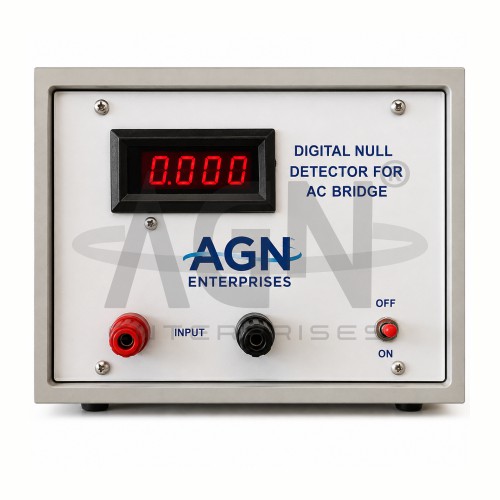
The Digital Null Detector from AGN Enterprises is a sensitive electronic laboratory instrument designed to detect and display the null or balance condition in AC bridge experiments. It provides a clear digital indication of the detector signal, allowing students to identify the balance point conveniently during precision electrical measurements.
The illustrated instrument features a four-digit LED display, input terminals, power switch, indicator light, and robust bench-top enclosure. The front panel clearly identifies the unit as a Digital Null Detector for AC Bridge, making it particularly suitable for bridge experiments where students need to locate a minimum or zero-response condition.
The Digital Null Detector is suitable for physics laboratories, electrical engineering laboratories, electronics laboratories, colleges, universities, polytechnics, technical institutes, and scientific training laboratories.
The Digital Null Detector works by sensing a small electrical signal across the detector branch of a bridge circuit.
First, students connect the detector to the appropriate bridge terminals. Next, they adjust the bridge parameters while observing the digital display.
As the bridge approaches balance, the detector signal decreases. Students continue adjusting the bridge until they obtain the required minimum or null indication.
Therefore, the instrument provides a convenient electronic method for locating the balance condition.
The illustrated unit incorporates a prominent four-digit LED display.
The display allows students to observe changes in detector response directly while adjusting an AC bridge. Moreover, the digital indication makes small changes easier to follow during laboratory demonstrations and practical exercises.
This feature provides a convenient alternative to traditional pointer-based null detectors for compatible experiments.
A null condition occurs when the electrical quantities in a bridge reach the required balance relationship.
At or near this condition, the signal across the detector branch becomes minimum according to the bridge arrangement.
The Digital Null Detector helps students identify this point clearly. Consequently, they can record the corresponding bridge settings and calculate the unknown electrical quantity.
The shown instrument is specifically identified for use with AC bridge experiments.
AC bridges allow students to investigate electrical quantities such as:
The exact application depends on the bridge circuit connected to the detector.
The Digital Null Detector supports the bridge balance method, an important technique in electrical measurement.
First, students establish the required bridge circuit. Then, they adjust one or more bridge parameters while watching the detector response.
When the detector reaches the appropriate minimum indication, the bridge approaches its balance condition. Students can then determine the unknown quantity from the bridge equation.
Thus, the detector helps connect theoretical balance equations with practical measurements.
Null measurement differs from ordinary direct measurement because the user looks for a minimum or zero difference between two electrical conditions.
This technique forms the basis of many precision bridge experiments.
Furthermore, null methods help students understand concepts such as:
Electrical Balance
Signal Comparison
Impedance Measurement
Bridge Ratios
Measurement Sensitivity
Precision Instrumentation
The front panel includes clearly accessible input terminals for connecting the detector to a compatible bridge circuit.
The color-coded terminals simplify laboratory connections and help students identify the detector input points.
Users should always follow the relevant experimental circuit diagram and observe the specified input limits.
The illustrated unit includes a convenient ON/OFF power switch and status indication.
The straightforward front-panel arrangement allows students to operate the instrument easily during practical sessions.
Before making or changing experimental connections, users should switch off the relevant equipment whenever the laboratory procedure requires it.
The Digital Null Detector can complement a compatible Campbell Bridge Trainer during mutual inductance experiments.
Students adjust the Campbell Bridge controls while monitoring the detector. As the bridge approaches balance, the detector helps identify the minimum-response condition.
Therefore, the combination provides an effective setup for teaching mutual inductance and AC bridge measurement.
The detector can also support compatible inductance bridge experiments.
Depending on the laboratory setup, students may use an AC bridge to determine an unknown inductance by comparing it with known resistance, capacitance, or inductance values.
The detector then helps identify the bridge balance point required for the calculation.
Compatible capacitance bridge experiments can also benefit from digital null detection.
Students vary the appropriate bridge parameters and monitor the detector until they locate the balance condition.
Consequently, the apparatus can support practical lessons involving capacitance, reactance, impedance, and AC circuit measurement.
Depending on the experiment, the Digital Null Detector may operate with:
AC Bridge Trainer
Campbell Bridge
Inductance Bridge
Capacitance Bridge
Suitable AC Source
Connecting Leads
Experimental Components
The exact input range, sensitivity, operating frequency range, supply requirements, and compatible bridge specifications depend on the supplied model.
The Digital Null Detector helps students develop practical skills in:
Moreover, the clear digital display helps instructors demonstrate bridge-balancing procedures to students.
In physics laboratories, the detector can support experiments involving alternating current, bridge circuits, inductance, capacitance, impedance, mutual inductance, and electrical measurement.
Students can observe how changes in bridge parameters influence the detector response. As a result, they gain a clearer understanding of balance conditions in AC circuits.
The Digital Null Detector is also useful for practical training in:
Electrical Measurements
AC Circuit Analysis
Instrumentation
Bridge Networks
Impedance Measurement
Inductance Measurement
Capacitance Measurement
Therefore, the instrument provides a useful addition to electrical engineering and electronics teaching laboratories.
First, users should connect the Digital Null Detector to the specified detector points of the AC bridge.
Next, they should switch on the required instruments and adjust the bridge controls according to the experimental procedure.
Students can then observe the display while approaching the balance condition. Fine adjustment near the null point helps identify the appropriate minimum response.
Finally, students record the bridge settings and complete the required calculations.
Users should operate the detector only within its specified electrical limits.
Furthermore, students should check all circuit connections before applying power. They should avoid short circuits and should not apply an unsuitable voltage directly to the detector input.
Users should also keep the instrument away from liquids, excessive moisture, and corrosive chemicals.
Users should keep the display, terminals, switches, and enclosure clean and dry.
Connecting leads should be inserted and removed carefully to prevent terminal damage. In addition, users should inspect laboratory leads regularly for loose connections or damaged insulation.
After use, students should switch off the instrument and store it in a clean, dry laboratory environment.
The Digital Null Detector is suitable for:
AGN Enterprises supplies Digital Null Detectors, Campbell Bridge Trainers, AC bridges, electrical measurement trainers, resistance bridges, inductance apparatus, capacitance apparatus, and physics laboratory instruments.
Furthermore, our educational equipment supports practical electrical measurement, engineering education, electronics training, physics experiments, and laboratory demonstrations.