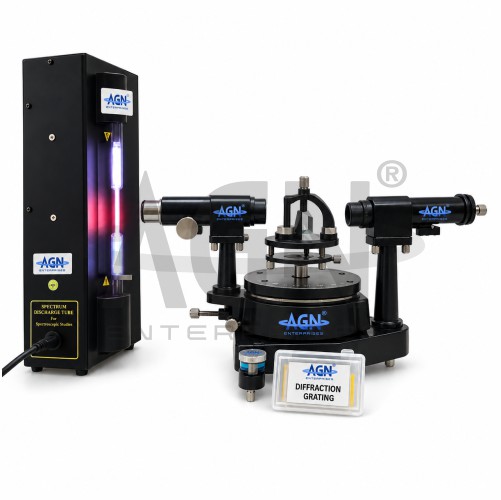
The Rydberg Constant Measurement setup helps students determine the Rydberg constant through the study of atomic spectra. It provides a practical method for understanding spectral lines, atomic energy levels, and electronic transitions. Therefore, the setup is suitable for physics laboratories in colleges, universities, engineering institutions, and other educational organizations.
The Rydberg constant plays an important role in atomic physics and spectroscopy. Scientists use it to describe the wavelengths of spectral lines associated with hydrogen and hydrogen-like atoms. Moreover, this experiment connects theoretical concepts of atomic structure with practical spectral observations.
The experiment helps students study the relationship between wavelength and atomic energy transitions. During the practical, students observe characteristic spectral lines and analyze their wavelengths. They can then apply the Rydberg equation to experimental observations.
Furthermore, the setup develops practical skills in spectroscopy and scientific measurement. Students learn how spectral patterns provide information about atomic structure. They also gain experience in recording observations, performing calculations, and comparing experimental results with theoretical values.
The Rydberg Constant Measurement experiment provides a useful link between classical spectroscopy and modern atomic theory. As a result, students can understand why atoms produce discrete line spectra rather than continuous spectra.
Atoms absorb energy and move to excited states. However, these excited states do not remain stable indefinitely. When electrons move from higher energy levels to lower levels, atoms emit radiation at characteristic wavelengths.
In hydrogen, these transitions produce well-defined spectral series. For example, transitions associated with the Balmer series produce spectral lines that students can study experimentally. Therefore, students can use measured wavelength information with the Rydberg relation to determine the constant.
Moreover, the experiment demonstrates the connection between wavelength, electron transitions, and quantized atomic energy levels. Thus, it provides a practical introduction to fundamental concepts in atomic physics.
Educational institutions use this setup for atomic physics and spectroscopy practicals. It supports the study of hydrogen spectra, spectral wavelengths, energy levels, and fundamental physical constants. In addition, the experiment develops students’ skills in observation, calculation, and interpretation of scientific data.
AGN Enterprises supplies scientific instruments and educational experiment setups for institutional laboratories. Furthermore, you can explore our laboratory and educational products for additional physics laboratory requirements.
For authoritative scientific information about this fundamental constant, refer to the NIST Rydberg Constant reference.
AGN Enterprises supplies laboratory equipment and educational experiment setups for colleges, universities, engineering institutions, and teaching laboratories. Moreover, we focus on practical laboratory applications, clear product information, and solutions suitable for academic requirements.