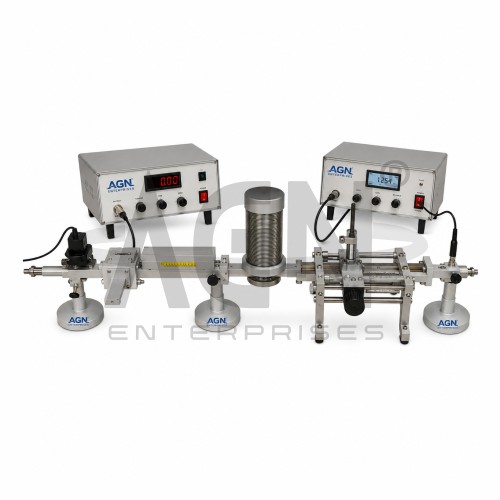
The Study of Microwave Components from AGN Enterprises is an educational laboratory setup designed for practical investigation of waveguide components, microwave transmission, power division, attenuation, coupling, isolation, and electromagnetic wave behavior. It enables engineering students to understand the construction, working principles, characteristics, and applications of commonly used microwave components through hands-on experiments.
Microwave systems use specialized components because conventional low-frequency circuit techniques become less suitable at very high frequencies. Therefore, waveguides and related devices are commonly used to guide, control, divide, combine, or terminate microwave energy. This experimental setup helps learners connect theoretical microwave concepts with the actual behavior of these components.
Depending on the supplied configuration, students can investigate components such as E-plane tees, H-plane tees, magic tees, directional couplers, attenuators, waveguide bends, twists, matched terminations, slotted sections, frequency meters, and detector mounts. Moreover, learners can study how individual components affect microwave power and signal propagation.
Students can connect suitable components to a compatible microwave test bench and observe their characteristics under different experimental conditions. Consequently, they gain practical experience in component identification, waveguide connections, microwave measurements, signal detection, and result analysis. Furthermore, the setup supports an understanding of parameters such as coupling, directivity, attenuation, isolation, power division, and transmission characteristics where applicable.
For further educational resources on microwave components and RF engineering, students can refer to the IEEE Microwave Theory and Technology Society.
The Study of Microwave Components setup provides a structured platform for demonstrating the operation and characteristics of commonly used microwave devices. In addition, instructors can use it to explain how different components manipulate electromagnetic energy within waveguide systems.