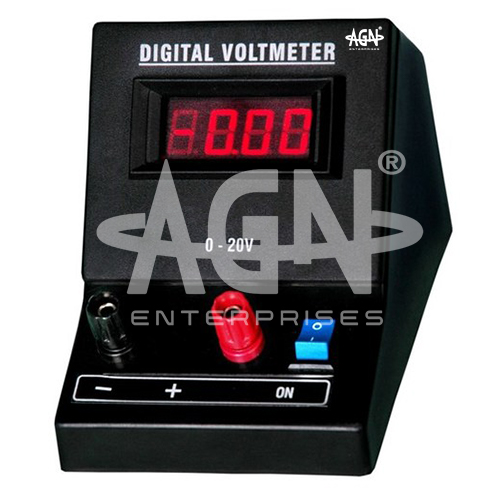
The Digital Galvanometer from AGN Enterprises is a sensitive laboratory measuring instrument designed for the detection and measurement of small electrical currents and current variations during physics, electrical, electronics, and instrumentation experiments. Its digital indication makes observations convenient while helping students perform sensitive electrical measurements with improved readability.
A galvanometer is commonly used to detect the presence, direction, or variation of small currents in an electrical circuit. In educational experiments, sensitive current detection becomes particularly important when determining balance or null conditions. Therefore, a digital instrument provides students with a clear method of observing small changes without relying solely on conventional pointer movement.
Moreover, the instrument can be integrated with suitable laboratory apparatus for experiments involving bridge circuits, resistance measurements, electromagnetic induction, potentiometers, magnetic measurements, and other compatible electrical experiments. Students can observe changes in current as experimental parameters are adjusted and identify the required balance or measurement condition.
The digital display also helps reduce reading difficulties associated with interpreting very small pointer deflections. Consequently, learners can focus on understanding experimental relationships, recording measurements, and analyzing results. Furthermore, the unit supports practical training in sensitive current measurement, null detection, circuit balancing, electrical connections, and laboratory instrumentation.
For additional information about electrical measurement science and standards, students can refer to the National Institute of Standards and Technology (NIST).
The Digital Galvanometer provides a convenient measurement solution for educational laboratories requiring sensitive current detection. In addition, instructors can integrate it with compatible experimental setups for demonstrations, null measurements, and quantitative observations.