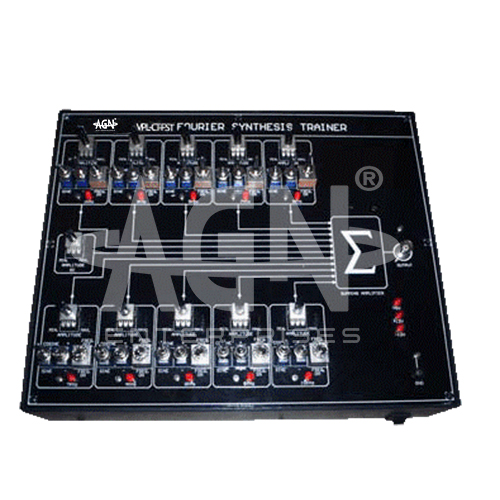
The Fourier Synthesis System Trainer from AGN Enterprises is an educational laboratory trainer designed for the practical study of Fourier series, harmonic components, waveform synthesis, frequency components, and signal analysis. It helps students understand how complex periodic waveforms can be represented and reconstructed by combining sinusoidal signals of different frequencies, amplitudes, and phases.
Fourier analysis is fundamental to electronics, communication engineering, signal processing, and control systems. According to Fourier theory, a periodic waveform can be expressed as a combination of a fundamental sinusoidal component and suitable harmonic components. Therefore, students can use the trainer to investigate how individual harmonics contribute to the final shape of a synthesized waveform.
Moreover, learners can study the effect of adding or removing different harmonic components while observing the resulting signal on a compatible oscilloscope. For example, suitable combinations of odd or even harmonics can demonstrate the progressive synthesis of square, triangular, and other periodic waveforms, depending on the experimental configuration. Consequently, students can visually connect mathematical Fourier-series expressions with actual electronic signals.
The trainer supports practical investigation of fundamental frequency, harmonics, amplitude relationships, phase relationships, waveform distortion, signal composition, and frequency-domain concepts. Furthermore, students develop valuable skills in waveform observation, harmonic adjustment, oscilloscope operation, signal comparison, and experimental analysis.
For additional educational resources covering signal processing and Fourier analysis, students can refer to the IEEE Signal Processing Society.
The Fourier waveform training system provides a structured platform for demonstrating how complex periodic signals are constructed from sinusoidal components. In addition, instructors can visually demonstrate the contribution of successive harmonics and explain the relationship between time-domain waveforms and their frequency components.