

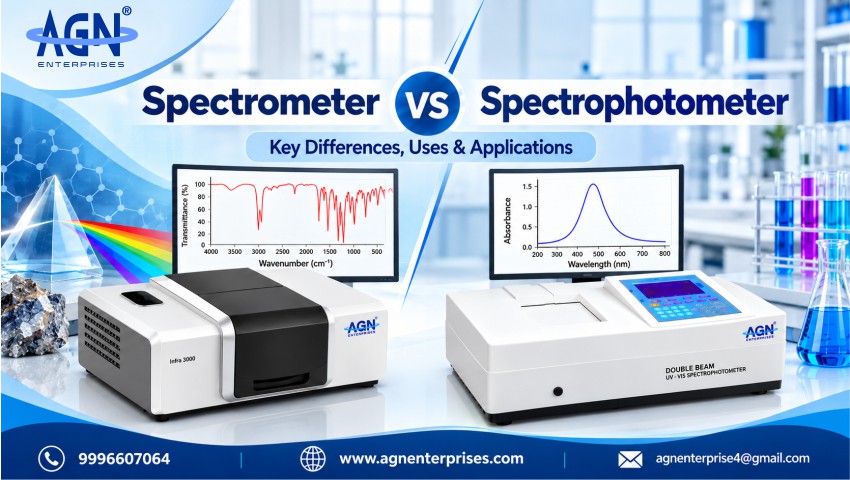
Spectrometer vs Spectrophotometer is an important comparison for laboratories selecting analytical and spectroscopy equipment. Although both instruments analyze electromagnetic radiation, they can perform different measurements depending on their design and application.
Both instruments are used in scientific, pharmaceutical, chemical, educational, environmental, and research laboratories. However, their measurement objectives, optical configurations, and applications can differ.
Therefore, understanding the difference between a spectrometer and spectrophotometer helps laboratories select equipment according to their actual analytical requirements.
This guide explains what a spectrometer is, what a spectrophotometer is, how both instruments work, their key differences, types, applications, and important factors to consider before purchasing laboratory spectroscopy equipment.
In general, a spectrometer is an analytical instrument that measures and analyzes electromagnetic radiation according to wavelength, frequency, or related properties.
Depending on its design, a spectrometer can analyze radiation across different regions of the electromagnetic spectrum. The instrument can provide spectral information that helps researchers study the characteristics of samples, materials, or radiation sources.
Spectrometers are commonly used for:
However, the exact function of a spectrometer depends on its optical configuration, wavelength range, detector, and intended application.
A spectrophotometer is an analytical instrument that measures how much light a sample absorbs or transmits at selected wavelengths.
When light passes through a sample, the substances present in the sample absorb specific wavelengths. The spectrophotometer measures the intensity of light before and after the light interacts with the sample. It then uses these measurements to determine absorbance or transmittance.
Spectrophotometers are commonly used for:
For example, a UV-Vis spectrophotometer measures absorption in ultraviolet and visible wavelength regions. As a result, laboratories commonly use UV-Vis instruments for quantitative analysis.
For a detailed explanation, see our UV-Vis Spectrophotometer: Principle, Parts, Working, Uses & Applications guide.
Although these instruments are closely related, they do not always perform the same type of measurement.
| Feature | Spectrometer | Spectrophotometer |
|---|---|---|
| Primary purpose | Analyzes spectral characteristics | Measures light absorption or transmission |
| Measurement | Spectral intensity or related properties | Absorbance and/or transmittance |
| Wavelength analysis | Can analyze spectral distribution | Measures selected wavelengths or scans a wavelength range |
| Sample analysis | Depends on instrument type | Commonly designed for sample-based analysis |
| Concentration analysis | Depends on configuration | Commonly used for quantitative concentration analysis |
| Applications | Research, material analysis, spectroscopy and characterization | Pharmaceutical, chemical, environmental, food and educational analysis |
| Optical configuration | Varies according to application | Designed around sample measurement |
| Typical output | Spectrum or spectral information | Absorbance, transmittance or concentration-related results |
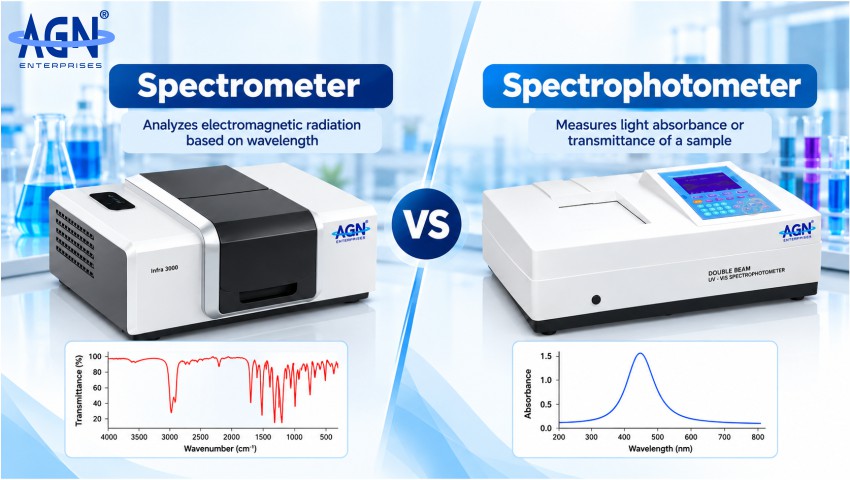
The exact terminology can vary between manufacturers and scientific applications. Therefore, laboratories should always check the technical specifications and intended function of an instrument before purchasing it.
The spectrometer vs spectrophotometer distinction becomes clearer when the measurement objective, sample type, wavelength range, and required analytical output are considered.
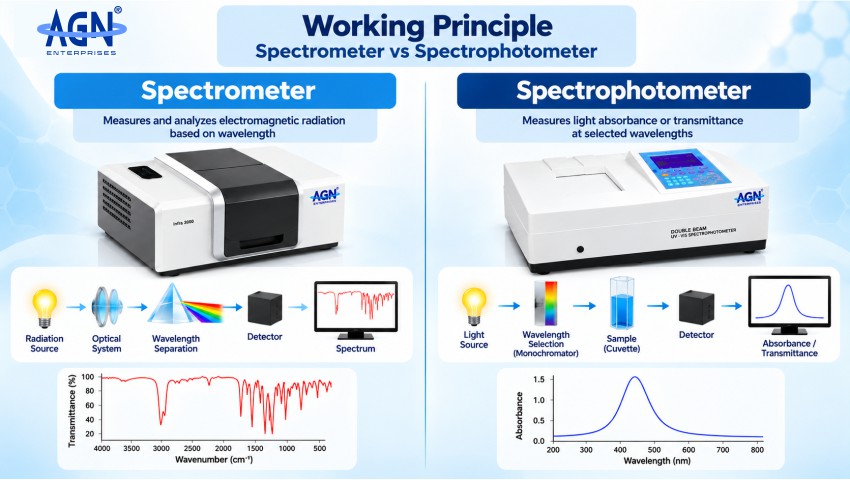
A spectrometer generally separates or analyzes radiation according to wavelength and then measures the resulting signal.
A simplified process looks like this:
Radiation Source → Optical System → Wavelength Separation → Detector → Signal Processing → Spectrum
Depending on the instrument, the system may use a suitable radiation source or analyze radiation produced or emitted by the sample.
Next, lenses, mirrors, slits, gratings, or other optical components direct and control the radiation.
An optical component, such as a diffraction grating, separates radiation according to wavelength.
The detector measures the intensity of the radiation at different wavelengths.
Finally, the instrument processes the detector signal and displays the resulting spectral information.
The exact working principle varies according to the type of spectrometer and its intended application.
A spectrophotometer measures the amount of radiation that a sample absorbs or transmits.
The basic process is:
Light Source → Wavelength Selection → Sample → Detector → Signal Processing → Result
First, the instrument produces light using an appropriate source for the required wavelength range.
Next, the optical system selects the wavelength or wavelength range required for the analysis.
The selected light passes through a sample contained in an appropriate cuvette or sample holder.
The detector measures the intensity of the transmitted light.
The instrument compares the measured intensity with a reference or blank. It then calculates absorbance or transmittance.
Finally, the instrument displays the result as absorbance, transmittance, a spectrum, or concentration, depending on the instrument and analytical method.

The terms spectrometer and spectrophotometer are closely related, but they do not necessarily describe the same instrument.
A spectrometer represents a broader category of analytical instruments that measure or analyze spectral information. In contrast, a spectrophotometer specifically measures the interaction of light with a sample, particularly its absorption or transmission.
For this reason, laboratories should not select equipment based only on the instrument name.
Instead, buyers should consider the measurement they need, the sample type, the wavelength range, and the analytical method.
Different spectrometers serve different scientific and industrial applications.
A UV-Vis spectrometer analyzes ultraviolet and visible radiation. Depending on its configuration, it can support spectral characterization and quantitative applications.
An infrared spectrometer analyzes infrared radiation. Researchers commonly use infrared spectroscopy to study molecular vibrations and chemical characteristics.
A Raman spectrometer analyzes Raman scattering from a sample. As a result, researchers can obtain information about molecular and material characteristics.
An X-ray spectrometer analyzes X-ray radiation and can support elemental or material analysis, depending on the instrument design.
Therefore, laboratories should select the spectrometer type according to the sample, analytical objective, wavelength region, and required spectroscopy technique.
Spectrophotometers are available in different configurations for different laboratory applications.
A UV-Vis spectrophotometer measures absorption in ultraviolet and visible wavelength regions. Pharmaceutical, chemical, educational, environmental, and research laboratories commonly use these instruments.
A visible spectrophotometer operates primarily in the visible region. Laboratories can use these instruments for samples that absorb visible light.
A single-beam spectrophotometer measures the reference and sample separately. Therefore, it can provide a practical solution for routine analysis and educational applications.
A double-beam spectrophotometer uses reference and sample measurement paths. This configuration can improve measurement stability for suitable analytical applications.
A microvolume spectrophotometer allows laboratories to analyze samples when only very small sample volumes are available. Consequently, these instruments can be useful for specialized research applications.
For another overview of the differences between these two instruments, see this Spectrometer vs Spectrophotometer guide.
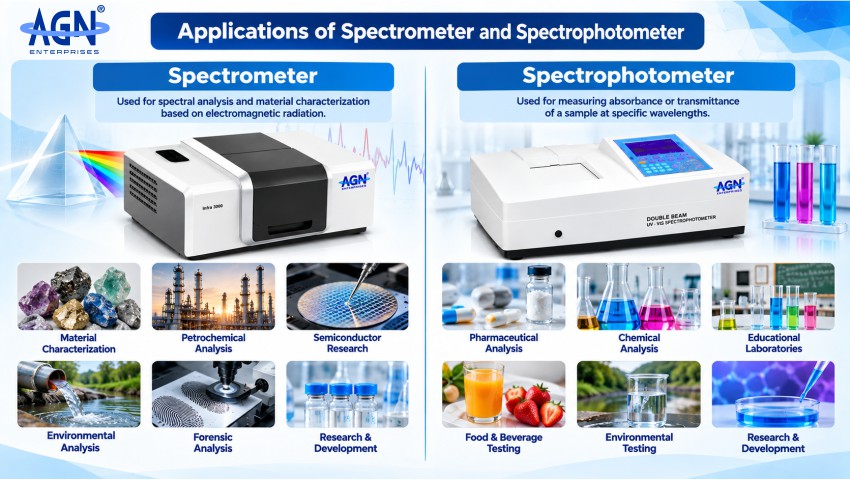
Spectrometers support a wide range of scientific and industrial applications.
Pharmaceutical researchers can use spectroscopic techniques to characterize materials, investigate compounds, and support analytical development.
Chemical laboratories can use spectrometers to obtain spectral information for identifying or characterizing chemical substances.
In material science, researchers use spectrometers to study the composition and properties of different materials.
Environmental laboratories can use suitable spectroscopic techniques to analyze environmental samples and selected pollutants.
Similarly, research laboratories use different spectrometers to study molecular, chemical, and material characteristics.
Spectrophotometers are particularly useful when laboratories need to measure absorbance or transmittance.
Pharmaceutical laboratories can use spectrophotometers for:
However, the laboratory should select the instrument according to the applicable analytical method and validation requirements.
Chemical laboratories use spectrophotometers for quantitative analysis, concentration measurements, reaction monitoring, and other analytical procedures.
Schools, colleges, and universities use spectrophotometers to demonstrate:
As a result, spectrophotometers can provide students with practical experience in analytical measurement.
Environmental laboratories can use spectrophotometers for various water and environmental analyses when appropriate analytical methods are available.
Food and beverage laboratories can use spectrophotometers for selected quantitative and quality-control applications.
The spectrometer vs spectrophotometer comparison becomes particularly important in pharmaceutical laboratories because different analytical methods require different types of measurements.
A pharmaceutical laboratory may select a spectrometer when it needs spectral information or characterization using a specific spectroscopy technique.
On the other hand, a laboratory may select a spectrophotometer when its analytical method requires absorbance or transmittance measurements at specific wavelengths.
Therefore, pharmaceutical laboratories should consider:
The laboratory should match these requirements with the instrument specifications before making a purchase.
There is no single instrument that suits every laboratory application.
Therefore, the correct choice depends on the measurement your laboratory needs to perform.
First, determine whether you need spectral characterization, absorbance measurement, transmittance measurement, concentration determination, or another analytical measurement.
Next, identify the wavelength region required by your analytical method.
Consider whether your laboratory will analyze liquids, solids, powders, gases, or other materials.
Routine educational applications may require different performance specifications than pharmaceutical quality-control or research applications.
Furthermore, advanced analytical applications may require spectral scanning, data storage, reporting, and other software functions.
For quality-control and regulated laboratory applications, consider calibration procedures, performance verification, and documentation requirements.
Finally, consider installation, training, maintenance, calibration, warranty, and technical support when comparing instruments.
Different laboratories have different analytical requirements. Consequently, equipment selection should reflect the intended application.
Educational laboratories may require instruments that offer:
Pharmaceutical laboratories may require:
Research laboratories may require:
Before purchasing a spectrometer or spectrophotometer, prepare a technical requirement based on the laboratory’s actual application.
For example, consider the following checklist:
This approach makes it easier to compare specifications and quotations from different laboratory equipment suppliers.
AGN Enterprises supplies laboratory equipment and scientific instruments for pharmaceutical, educational, research, chemical, and industrial laboratory applications.
When laboratories require analytical or spectroscopy equipment, AGN can assist buyers with product specifications and application-based equipment requirements.
AGN’s laboratory equipment portfolio covers different categories of scientific, analytical, educational, and pharmaceutical laboratory equipment.
For institutional and laboratory procurement, buyers can discuss:
Instead of selecting equipment only according to price, laboratories should compare technical specifications with the intended analytical method and application.
Before finalizing laboratory equipment, check the following:
As a result, a detailed technical comparison can help laboratories avoid purchasing equipment that does not match their actual requirements.
The answer depends on the intended laboratory application.
A spectrometer may be appropriate when the laboratory needs spectral analysis or characterization using a particular spectroscopy technique.
A spectrophotometer may be appropriate when the laboratory needs to measure absorbance or transmittance and perform quantitative analysis using a suitable analytical method.
Therefore, rather than asking which instrument is universally better, laboratories should first identify the required measurement and then compare suitable specifications.
A spectrophotometer is a specialized spectroscopic instrument designed to measure light absorption or transmission through a sample.
A spectrometer measures and analyzes spectral information. Its exact application depends on the type of spectrometer, wavelength range, detector, and analytical method.
A spectrophotometer commonly measures absorbance or transmittance and can support quantitative concentration analysis when the sample and analytical method are suitable.
UV-Vis spectroscopy can involve different types of instruments. However, a UV-Vis spectrophotometer specifically measures UV-visible absorbance or transmittance of samples.
A spectrophotometer is commonly used for concentration measurements when the substance absorbs suitable radiation and the analytical method supports spectrophotometric measurement.
Yes. Pharmaceutical researchers and laboratories use different spectrometers for research, characterization, and analytical applications, depending on the spectroscopy technique.
Consider the wavelength range, optical configuration, photometric performance, sample requirements, software, calibration, intended application, service support, and budget.
A spectrometer is a broader analytical instrument used to measure or analyze spectral characteristics, whereas a spectrophotometer specifically measures the absorption or transmission of light through a sample.
The spectrometer vs spectrophotometer comparison is important when laboratories select analytical and spectroscopy equipment.
A spectrometer generally analyzes spectral characteristics, while a spectrophotometer focuses on measuring light absorption or transmission through a sample. However, the exact terminology and configuration can vary between applications and manufacturers.
Therefore, laboratories should select equipment based on the analytical method, sample type, wavelength requirements, measurement objective, accuracy, software, calibration, and technical support.
For schools, colleges, pharmaceutical laboratories, research organizations, and industrial laboratories, AGN Enterprises can assist with laboratory equipment requirements, product specifications, and application-based procurement.