

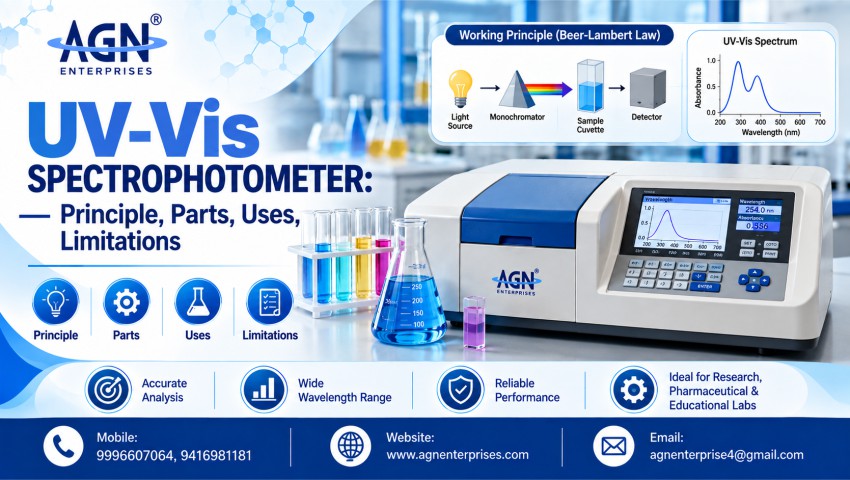
A UV-Vis spectrophotometer is an analytical instrument used to measure how much ultraviolet (UV) or visible light a sample absorbs at different wavelengths. It is widely used in pharmaceutical, chemical, environmental, food, educational, and research laboratories.
The instrument helps determine the concentration of substances, study absorption characteristics, and monitor the quality of different samples. Because of its versatility, UV-Vis spectroscopy is an important analytical technique for both routine testing and research.
This guide explains the UV-Vis spectrophotometer principle, parts, working, uses, applications, advantages, limitations, and important selection factors.
A UV-Vis spectrophotometer is a laboratory instrument that measures the absorption or transmission of ultraviolet and visible light through a sample.
When light passes through a sample, certain wavelengths may be absorbed by the molecules present in it. The instrument measures this interaction and produces an absorbance or transmission reading.

UV-Vis spectrophotometers are commonly used for:
For laboratories purchasing analytical instruments, the required wavelength range, accuracy, sample type, software, and application should be considered before selecting a model.
The UV-Vis spectrophotometer principle is based on the absorption of ultraviolet and visible radiation by molecules.
When radiation passes through a sample, molecules absorb specific wavelengths depending on their electronic structure. The instrument compares the intensity of light entering the sample with the intensity of light leaving it.
The resulting absorbance can then be related to the concentration of the absorbing substance.
Quantitative UV-Vis analysis commonly uses the Beer-Lambert law, which relates absorbance to concentration and optical path length.
The relationship is commonly expressed as:
A = εcl
Where:
This relationship allows laboratories to determine the concentration of a substance when appropriate calibration and measurement conditions are established.
For a detailed technical explanation of Beer-Lambert law and its application in spectrophotometric measurements, refer to this Beer-Lambert law guide
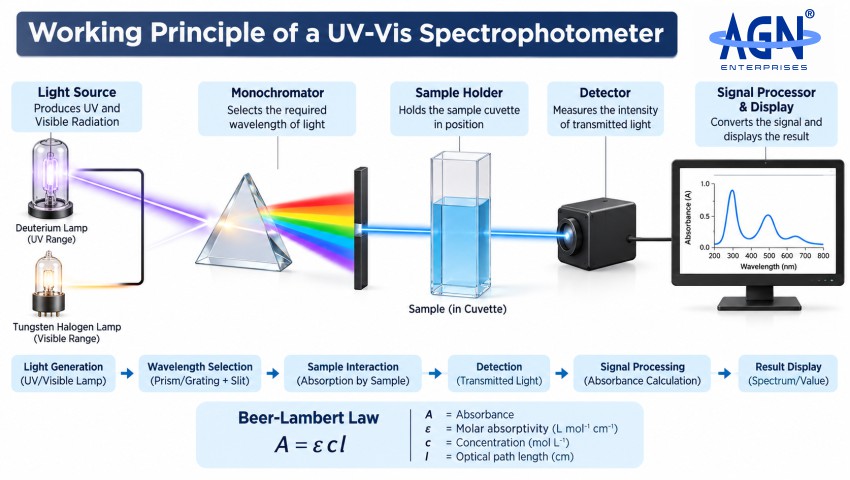
The working process can be understood through a series of steps:
Light source → Wavelength selection → Sample → Detector → Signal processing → Result
The instrument produces UV or visible radiation using an appropriate light source.
The optical system selects the required wavelength or wavelength range for the measurement.
The selected light passes through the sample held in a suitable cuvette.
A detector measures the intensity of transmitted light.
The instrument compares the measured signal with the reference or blank and calculates absorbance or transmission.
The result is presented through the instrument’s display or connected software, depending on the instrument configuration.

A UV-Vis spectrophotometer contains several optical, electronic, and sample-handling components.
| Part | Function |
|---|---|
| Light Source | Produces UV and/or visible radiation |
| Monochromator | Selects the required wavelength |
| Sample Holder | Holds the sample cuvette in position |
| Cuvette | Contains the liquid sample |
| Detector | Measures transmitted radiation |
| Optical System | Directs light through the instrument |
| Signal Processor | Converts detector output into useful measurements |
| Display/Software | Shows, records, and processes results |
The exact configuration varies between instruments. Some models also provide advanced software, automatic wavelength selection, scanning functions, multiple sample positions, and data-management features.
Different UV-Vis instruments are available for different laboratory requirements.
A single-beam instrument measures the reference and sample separately. It can be suitable for routine analytical and educational applications.
A double-beam instrument uses two optical paths or alternates measurements between the reference and sample. This configuration can improve measurement stability and is useful for more demanding analytical applications.
A scanning instrument measures absorbance across a selected wavelength range. It is useful when laboratories need to obtain absorption spectra rather than measurements at only one wavelength.
Microvolume instruments are designed for applications where only very small sample volumes are available. They are commonly used in research and biotechnology-related applications.
UV-Vis spectrophotometers are used across a wide range of laboratory environments.

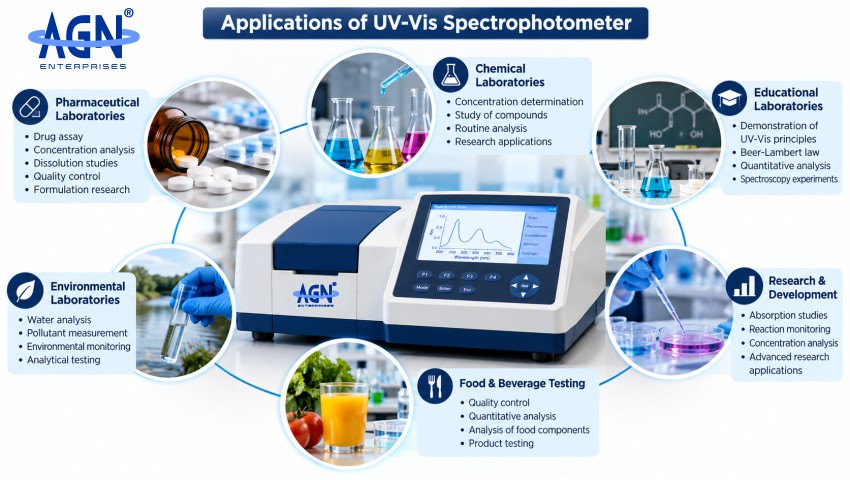
Pharmaceutical laboratories use UV-Vis spectroscopy for applications such as:
The exact analytical method depends on the substance, validated procedure, and applicable requirements.
In chemical laboratories, UV-Vis instruments can help determine concentrations and study the absorption characteristics of compounds.
They can be used in routine analysis as well as research applications.
Schools, colleges, and universities use UV-Vis spectrophotometers to demonstrate:
For educational laboratories, ease of operation, safety, training requirements, and budget can be important selection factors.
UV-Vis spectroscopy can be used for various environmental measurements, including analysis of substances in water and other samples where suitable analytical methods are available.
UV-Vis instruments can support quality-control and quantitative analysis of selected compounds in food and beverage samples.
Researchers use UV-Vis spectroscopy to investigate absorption behavior, reaction progress, concentration changes, and other analytical characteristics.
UV-Vis spectroscopy has an important role in pharmaceutical analysis because many compounds absorb UV or visible radiation.
Depending on the validated analytical method, the technique can support:
However, instrument selection should be based on the analytical method rather than simply choosing an instrument with the highest number of features.
For pharmaceutical laboratories, factors such as wavelength accuracy, photometric performance, repeatability, cuvette compatibility, software, calibration, and documentation may be particularly important.
Obtaining reliable measurements depends on both the instrument and the sample preparation process.
The selected wavelength should correspond appropriately with the analytical method and absorption characteristics of the sample.
Samples that are too concentrated or too dilute can affect measurement quality. Appropriate dilution and calibration procedures are therefore important.
Scratches, fingerprints, contamination, or unsuitable cuvette materials can affect measurements.
The solvent should be compatible with the analytical method and should not interfere significantly at the measurement wavelength.
Regular calibration and performance verification help maintain reliable measurements.
Inconsistent dilution, incomplete mixing, or contamination can produce inaccurate results even when the instrument itself is functioning correctly.
Although both instruments can be used for absorbance-based measurements, they are not identical.
| Feature | UV-Vis Spectrophotometer | Colorimeter |
|---|---|---|
| Wavelength Range | UV and/or visible, depending on model | Primarily visible range |
| Wavelength Selection | More precise | Usually uses filters or simpler wavelength selection |
| Spectral Analysis | Can scan across wavelengths | Generally more limited |
| Applications | Research, pharmaceutical, chemical, and QC analysis | Routine color-based testing and educational applications |
| Flexibility | Generally higher | Generally simpler |
| Cost | Often higher | Usually lower |
The appropriate choice depends on the analytical application, required accuracy, and available budget.
Before purchasing a UV-Vis spectrophotometer, laboratories should consider the following factors.
Check whether the instrument covers the wavelength range required for the intended applications.
Consider photometric accuracy, repeatability, and measurement range according to the laboratory’s requirements.
Determine whether a single-beam, double-beam, or another configuration is appropriate.
Consider the type and volume of samples that will be tested and the required cuvette or sample holder.
For laboratories handling large amounts of analytical data, software functionality can be an important consideration.
Ask about calibration procedures, documentation, and available technical support.
A spectrophotometer for a teaching laboratory may have different requirements from one intended for pharmaceutical quality control or research.
Availability of installation assistance, technical support, spare parts, and maintenance should also be considered.
Not every laboratory needs the same instrument configuration.
Educational institutions may prioritize:
Pharmaceutical laboratories may require:
Research environments may benefit from:
AGN Enterprises provides laboratory equipment and scientific instruments for educational, pharmaceutical, research, and industrial laboratory applications.
When selecting analytical equipment, AGN can assist buyers in matching equipment specifications with their intended application rather than selecting equipment only on the basis of price.
AGN’s laboratory equipment portfolio covers different categories of analytical instruments, scientific equipment, educational laboratory equipment, and pharmaceutical laboratory equipment.
For institutions and laboratories, AGN can also support requirements involving:
If your laboratory is planning to purchase analytical equipment, discuss your application, sample type, required wavelength range, quantity, and technical specifications before finalizing the instrument.
Before placing an order, prepare a basic requirement list:
This makes it easier to compare different instruments and obtain an appropriate quotation.
UV-Vis spectroscopy offers several practical advantages:
The actual suitability depends on the sample, analytical method, and instrument configuration.
Despite its wide use, UV-Vis spectroscopy has limitations.
Therefore, laboratories should select the analytical method and instrument together.
A UV-Vis spectrophotometer measures the absorption or transmission of ultraviolet and visible light through a sample. It is used for quantitative analysis, concentration determination, spectroscopy, quality control, and research.
The instrument works by measuring how much UV or visible radiation a sample absorbs at selected wavelengths. Quantitative measurements commonly use the Beer-Lambert relationship between absorbance and concentration.
Major components include a light source, wavelength-selection system, sample holder, cuvette, detector, optical system, signal processor, and display or software.
A UV-Vis spectrophotometer generally provides broader wavelength capability and greater analytical flexibility, while a colorimeter is typically designed for simpler measurements in the visible range.
Yes. UV-Vis spectrophotometers can be used for various pharmaceutical analytical applications, including assay and concentration measurements, provided the method is appropriate and properly validated.
Consider the required wavelength range, photometric performance, optical configuration, sample requirements, software, calibration, application, service support, and budget.
A UV-Vis spectrophotometer is a versatile analytical instrument used in pharmaceutical, chemical, educational, environmental, food, and research laboratories. Its ability to measure the absorption of UV and visible radiation makes it useful for concentration determination, quantitative analysis, and spectroscopic studies.
Understanding the principle, parts, working, applications, advantages, and limitations helps laboratories select an instrument that matches their actual requirements.
For schools, colleges, pharmaceutical laboratories, and research organizations, the right choice should be based on the intended application, technical specifications, sample requirements, and available support. AGN Enterprises can assist institutions and laboratories with their scientific and analytical equipment requirements, including product selection, specifications, and bulk procurement.