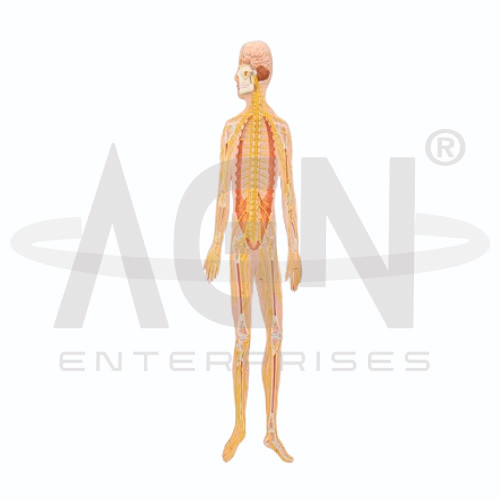
The Nervous System Model from AGN Enterprises is an anatomical teaching aid designed to demonstrate the major components and organization of the human nervous system. It provides students with a clear visual representation of the brain, spinal cord, cranial nerves, spinal nerves, and major peripheral nerves distributed throughout the human body.
This educational model is suitable for medical colleges, nursing institutes, physiotherapy colleges, paramedical institutions, schools, biology laboratories, anatomy departments, and health-science training centers.
The nervous system is the body’s primary communication and control network. It receives sensory information, processes signals, and coordinates responses involving different organs and tissues.
The teaching aid may demonstrate structures such as:
Brain
Spinal Cord
Cranial Nerves
Spinal Nerves
Peripheral Nerves
Nerves of the Upper Limbs
Nerves of the Lower Limbs
Major Nerve Pathways
The exact structures and level of anatomical detail may vary according to the supplied model configuration.
The central nervous system (CNS) consists of the brain and spinal cord.
The brain processes and integrates information and participates in the control of sensory, motor, cognitive, and many physiological functions.
The spinal cord provides an important communication pathway between the brain and peripheral regions of the body and also participates in reflex activity.
The model helps learners visualize the continuity between these two major structures.
The Nervous System Model also supports the study of the peripheral nervous system (PNS).
The PNS includes neural structures outside the brain and spinal cord. Cranial and spinal nerves connect the central nervous system with different parts of the body.
Students can observe how peripheral nerves extend toward the head, trunk, upper limbs, and lower limbs, helping them understand the overall distribution of nerves.
Cranial nerves arise from the brain, while spinal nerves are associated with the spinal cord.
Where represented, the teaching model can help students identify these nerves and understand their general distribution.
The three-dimensional presentation provides a useful foundation for studying neuroanatomy, sensory pathways, motor pathways, and peripheral nerve organization.
The model can be used to introduce the functional organization of neural pathways.
Sensory pathways carry information from receptors toward the central nervous system.
Motor pathways transmit commands from the central nervous system toward muscles and other effectors.
A simplified sequence is:
Stimulus → Sensory Input → CNS Processing → Motor Output → Response
This allows students to connect anatomical structures with basic nervous-system functions.
The teaching aid can also support lessons involving reflex pathways.
A reflex is a rapid, relatively automatic response to a stimulus. A simplified reflex arc may involve a receptor, sensory neuron, integration center, motor neuron, and effector.
Studying the spinal cord and peripheral nerves together helps learners understand the anatomical basis of basic reflex responses.
This anatomical teaching aid transforms the complex distribution of nerves into a clear visual learning experience. Students can observe the relationship between the brain, spinal cord, and peripheral nerves while developing a better understanding of the body’s communication network.
It is useful for teaching human anatomy, neuroanatomy, nervous-system organization, nerve distribution, reflexes, sensory pathways, motor pathways, and basic neurophysiology.
The model complements anatomical charts and textbooks while supporting identification, spatial visualization, revision, and practical demonstrations.
AGN Enterprises supplies anatomical models, biological teaching aids, pathological models, and educational laboratory equipment for schools, medical colleges, nursing institutes, physiotherapy programs, paramedical institutions, and professional training centers.
Our anatomical teaching aids provide clear visual representations to help learners understand complex human-body structures and systems.