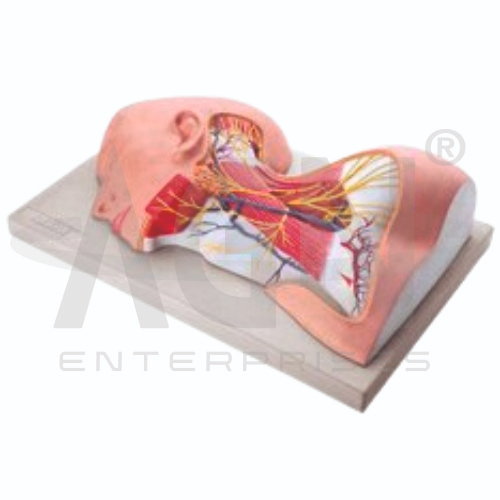
The Nerves of Neck Region Model from AGN Enterprises is an anatomical teaching model designed to demonstrate the major nerves and related anatomical structures of the human neck. It helps students visualize the course, distribution, and relationships of cervical nerves with surrounding muscles, blood vessels, and other structures represented on the model. It is suitable for medical colleges, nursing institutes, physiotherapy colleges, paramedical institutions, anatomy laboratories, and health-science education.
The Nerves of Neck Region Model provides a three-dimensional representation of important neural structures within the cervical region.
Depending on the specific model configuration, it may demonstrate structures such as:
Cervical Spinal Nerves
Cervical Plexus
Phrenic Nerve
Vagus Nerve
Accessory Nerve
Sympathetic Trunk
Branches of the Cervical Plexus
Related Muscles and Blood Vessels
The model allows students to understand how nerves travel through the neck and relate spatially to surrounding anatomical structures.
The cervical plexus is formed primarily by the anterior rami of the upper cervical spinal nerves, classically C1–C4.
Its branches contribute to sensory and motor innervation of structures in the head, neck, and nearby regions.
The model can help students identify the general position and distribution of these branches and understand their relationship with cervical anatomy.
The Nerves of Neck Region Model can be particularly useful for demonstrating the course of the phrenic nerve, where represented.
The phrenic nerve arises mainly from cervical spinal nerve roots C3–C5 and provides the principal motor innervation to the diaphragm.
Its cervical course provides an important anatomical connection between the neck and thorax, making it relevant to anatomy, physiology, and clinical education.
Depending on the model, teachers may also demonstrate important neural structures passing through the neck, including the vagus nerve, accessory nerve, and cervical sympathetic trunk.
These structures allow students to explore how the neck serves as an important passage for nerves connecting the brain, spinal cord, thorax, and other regions.
The model can therefore support both regional anatomy and introductory neuroanatomy lessons.
The Nerves of Neck Region Model provides a three-dimensional alternative to flat anatomical diagrams. Students can observe the position and course of nerves while studying their relationship with nearby anatomical structures.
Teachers can use the model for lessons involving regional anatomy, cervical plexus, peripheral nerves, cranial nerves, neuroanatomy, muscular innervation, and clinical anatomy.
The visual format supports anatomical identification, spatial understanding, memorization, and the study of nerve pathways.
AGN Enterprises supplies anatomical models, biological teaching aids, and educational laboratory equipment for medical colleges, nursing institutes, physiotherapy programs, paramedical institutions, schools, and professional training centers.
Our anatomical models help learners understand complex structures through clear three-dimensional representations and practical demonstrations.