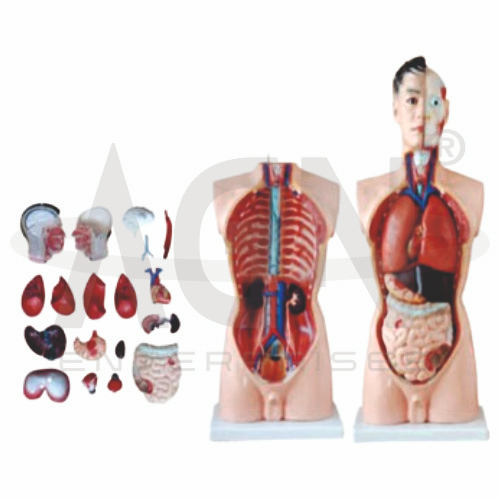
The Male Torso 19 Parts, Fibre from AGN Enterprises is a detailed anatomical teaching model designed to demonstrate the major internal organs and structures of the human male torso. Constructed from fibre material, the model provides a practical three-dimensional representation of human anatomy for classroom demonstrations and laboratory study.
The 19-part configuration allows students to examine multiple anatomical structures individually and understand their positions and relationships within the torso. It is suitable for medical colleges, nursing institutes, paramedical institutions, physiotherapy colleges, schools, anatomy laboratories, and health-science training centers.
This teaching model provides an overview of several major body systems within a single anatomical representation.
Depending on the specific configuration, structures may include:
Head and Brain Structures
Lungs
Heart
Liver
Stomach
Intestines
Kidneys
Urinary Bladder
Male Reproductive Structures
Other Thoracic and Abdominal Organs
The exact division and removable components should be confirmed from the supplied 19-part model.
A key feature of the Male Torso 19 Parts, Fibre is its multi-part construction. Removable components allow students to study internal organs individually and then observe how they fit together within the body.
This approach supports hands-on learning of:
Organ Identification
Organ Position
Thoracic Anatomy
Abdominal Anatomy
Pelvic Anatomy
Relationships Between Body Systems
The model is especially useful when teaching students who are beginning their study of human anatomy.
The thoracic region can be used to demonstrate major structures associated with the respiratory and cardiovascular systems.
Where represented, students may examine the lungs, heart, major airways, and related structures.
Removing selected components can provide a clearer view of deeper structures and help learners understand their relative positions within the chest.
The abdominal section provides a visual representation of important digestive and urinary organs.
Depending on the configuration, students may study the liver, stomach, intestines, kidneys, and associated structures.
This allows teachers to explain how organs from different systems are arranged within the abdominal cavity.
As a male torso model, the lower region may demonstrate structures associated with the male urinary and reproductive systems.
This provides an opportunity to introduce male pelvic anatomy alongside the digestive and urinary organs represented in the torso.
The three-dimensional arrangement helps students understand anatomical relationships that can be difficult to appreciate from textbook diagrams alone.
The fibre construction makes the model suitable for repeated educational demonstrations when handled and maintained appropriately.
Its three-dimensional design provides a clear physical reference for students studying the location, shape, and arrangement of major human organs.
The removable-part format further supports interactive and practical anatomy lessons.
This anatomical torso is useful for teaching multiple body systems with a single model. Students can remove, identify, examine, and reposition individual components while learning their anatomical locations.
It can support lessons involving human anatomy, organ systems, digestive anatomy, respiratory anatomy, cardiovascular anatomy, urinary anatomy, and male reproductive anatomy.
The model encourages visual and hands-on learning while helping students develop spatial understanding of internal human anatomy.
AGN Enterprises supplies anatomical models, biological teaching aids, pathological models, and educational laboratory equipment for schools, medical colleges, nursing institutes, physiotherapy programs, paramedical institutions, and professional training centers.
Our anatomical teaching models support practical demonstrations and help learners understand complex human-body structures through clear three-dimensional representations.