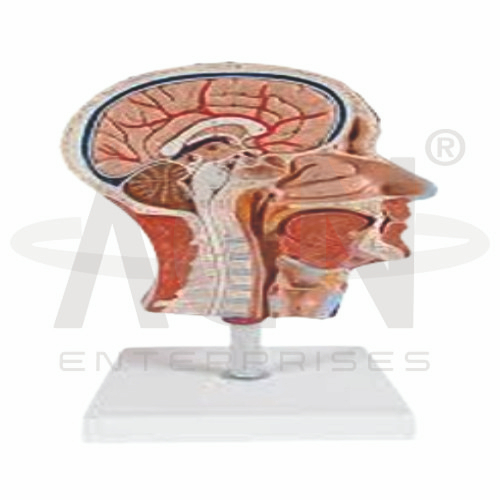
The Half Head Life Size Model from AGN Enterprises is a detailed anatomical teaching aid designed to demonstrate the internal structures of the human head in a sectional view at approximately natural size. The model helps students understand the anatomical relationships between the brain, nasal cavity, oral cavity, pharynx, tongue, and other structures of the head and upper neck.
It is suitable for medical colleges, nursing institutes, physiotherapy colleges, paramedical institutions, dental colleges, anatomy laboratories, biology departments, and health-science training centers.
The Half Head Life Size Model provides a sectional representation of important structures within the human head.
Depending on the specific model configuration, represented structures may include:
Brain
Cerebral Structures
Nasal Cavity
Oral Cavity
Tongue
Palate
Pharynx
Upper Respiratory Passage
Upper Digestive Passage
Associated Head and Neck Structures
The exact structures, colors, removable components, and anatomical details may vary according to the supplied model.
A major advantage of the model is its approximately life-size anatomical representation.
Natural proportions help students develop a realistic understanding of the size, position, and relationships of structures within the human head.
This makes the model particularly useful for practical demonstrations and anatomical orientation.
Where represented, the model demonstrates important portions of the brain within the cranial cavity.
The sectional design allows students to study the relationship between neural structures and surrounding regions of the head.
It can complement other brain and nervous-system models when teaching basic neuroanatomy.
The nasal cavity forms an important part of the upper respiratory tract.
The model can help students examine its location relative to the oral cavity, palate, and pharynx. Structures such as the nasal septum and associated internal features may be represented depending on the model configuration.
The oral region may demonstrate the mouth, tongue, palate, and associated structures.
These structures are important in mastication, swallowing, speech, taste, and the initial stages of digestion.
A sectional model provides a useful way to visualize their relationships with the nasal cavity and pharynx.
The pharynx is a muscular passage located behind the nasal and oral cavities.
It participates in both the respiratory and digestive systems, providing pathways for air and swallowed material.
The model helps students understand the position of the pharynx relative to other structures of the head and upper neck.
The Half Head Life Size Model is useful for demonstrating how the respiratory and digestive pathways are anatomically related.
Students can trace the general passage of air from the nasal or oral cavity toward the pharyngeal region while comparing this route with the pathway followed during swallowing.
This provides an effective introduction to functional head-and-neck anatomy.
The model provides students with a three-dimensional approach to studying complex sectional anatomy of the head.
Teachers can use it for lessons involving head anatomy, brain anatomy, nasal cavity, oral cavity, tongue, pharynx, respiratory passages, digestive passages, and head-and-neck anatomy.
Its life-size representation supports anatomical identification, spatial visualization, practical demonstrations, and examination preparation.
AGN Enterprises supplies anatomical models, head-and-neck models, neurological models, skeletal teaching aids, biological models, and educational laboratory equipment for medical colleges, nursing institutes, dental colleges, physiotherapy programs, and professional training centers.
Our anatomical teaching models provide clear three-dimensional representations for practical and classroom-based human anatomy education.