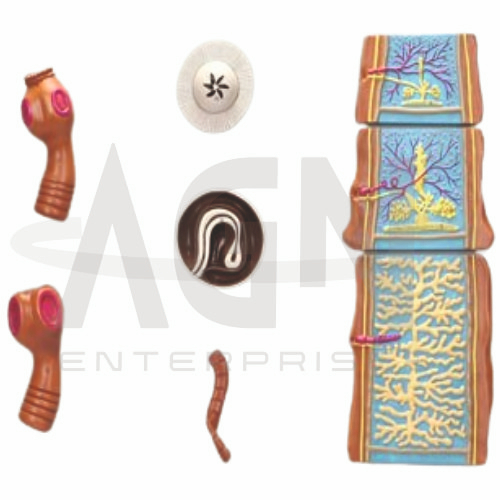
The Comparative Tapeworm Model from AGN Enterprises is an enlarged zoological and parasitology teaching aid designed to demonstrate and compare the important anatomical features of different tapeworms (cestodes). The model helps students study characteristic structures such as the scolex, neck, proglottids, reproductive regions, and segmented body organization.
It is suitable for medical colleges, veterinary colleges, nursing institutes, zoology departments, parasitology laboratories, biology departments, universities, and health-science training centers.
The Comparative Tapeworm Model provides enlarged representations for comparing important structural characteristics of tapeworms.
Depending on the specific model configuration, represented structures or specimens may include:
Scolex
Suckers
Hooks where applicable
Rostellum where applicable
Neck
Strobila
Immature Proglottids
Mature Proglottids
Gravid Proglottids
Reproductive Structures
The exact species, structures, colors, magnification, and comparative details may vary according to the supplied model.
Tapeworms belong to the class Cestoda and are parasitic flatworms.
Adult tapeworms typically have a flattened, elongated body composed of a specialized attachment region and a chain of segments.
The enlarged model allows students to examine these structures more clearly than would normally be possible with preserved specimens alone.
A major educational advantage of the model is its ability to support comparative parasitology.
Where multiple tapeworm types are represented, students can compare differences in features such as:
These differences can assist students in understanding the morphological basis used in cestode identification.
The scolex is the anterior attachment structure of a tapeworm.
Depending on the species, it may contain suckers, grooves, hooks, or other specialized structures that help the parasite attach to its host.
The model provides an enlarged representation that makes these important diagnostic features easier to study.
Many medically important tapeworms possess attachment structures on the scolex.
Suckers assist attachment to the intestinal wall, while hooks may occur in certain species.
Where represented, the comparative model allows students to observe differences between armed and unarmed scolex configurations.
The neck is a relatively narrow region immediately posterior to the scolex.
New proglottids develop from this region and become progressively more mature as they move farther along the strobila.
The model helps learners understand the relationship between the scolex, neck, and developing body segments.
The segmented body of a tapeworm is known as the strobila and consists of multiple segments called proglottids.
These are commonly described according to their developmental stage as:
Immature Proglottids
Mature Proglottids
Gravid Proglottids
The model helps students visualize how segment structure changes along the length of the tapeworm.
Mature proglottids contain developed reproductive structures.
Tapeworms are generally hermaphroditic, with individual mature segments containing both male and female reproductive organs.
Where represented, the enlarged model helps students identify important reproductive structures for parasitology study.
Gravid proglottids contain a uterus filled with developing eggs and represent a later stage of segment development.
The morphology of gravid segments can be useful when comparing different cestode species.
The model provides a clear visual aid for studying these differences.
Tapeworms include parasites of medical and veterinary significance.
Comparative study helps students understand how cestode morphology relates to parasite identification, host relationships, transmission, and life-cycle studies.
The model is intended for educational and laboratory demonstration rather than clinical diagnosis.
The Comparative Tapeworm Model provides students with an enlarged three-dimensional approach to studying cestode morphology.
Teachers can use it for lessons involving tapeworm anatomy, scolex structure, proglottids, cestode reproduction, parasite morphology, comparative zoology, helminthology, and parasitology.
It supports structural identification, comparative study, practical demonstrations, and examination preparation.
AGN Enterprises supplies zoological models, parasitology models, biological teaching aids, anatomical models, scientific instruments, and educational laboratory equipment for schools, colleges, universities, medical institutions, veterinary programs, and professional laboratories.
Our educational models provide clear three-dimensional representations for practical biology, zoology, and parasitology education.