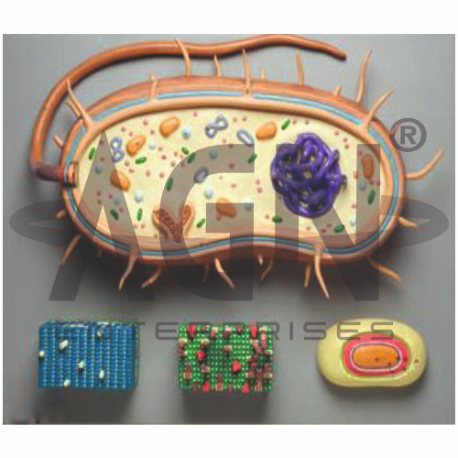
The Bacterium Model from AGN Enterprises is an enlarged microbiology teaching aid designed to demonstrate the general structure and internal organization of a bacterial cell. The model provides a three-dimensional representation of important bacterial components, helping students understand the basic morphology and cellular organization of prokaryotic organisms.
It is suitable for schools, colleges, universities, medical colleges, microbiology laboratories, biotechnology departments, nursing institutes, biology departments, and life-science training centers.
The Bacterium Model provides an enlarged representation of a generalized bacterial cell.
Depending on the specific model configuration, represented structures may include:
Capsule
Cell Wall
Plasma Membrane
Cytoplasm
Nucleoid
Bacterial DNA
Plasmids
Ribosomes
Flagellum
Pili or Fimbriae
Storage Granules
The exact structures, colors, magnification, shape, and removable components may vary according to the supplied model.
Bacteria are single-celled prokaryotic organisms. Unlike eukaryotic cells, they do not possess a membrane-bound nucleus.
Their genetic material is primarily located within a region of the cytoplasm called the nucleoid.
The enlarged model makes microscopic bacterial structures easier to identify and understand during classroom and laboratory demonstrations.
Some bacteria possess an external layer known as a capsule or glycocalyx.
Depending on the bacterial species, this layer can contribute to protection, surface attachment, biofilm formation, and interactions with the surrounding environment.
Where represented, the model helps students distinguish the capsule from the underlying cell wall.
The bacterial cell wall provides structural support and helps maintain cell shape.
In many bacteria, peptidoglycan is an important component of the cell wall.
The model provides a useful visual reference for understanding the position of the cell wall relative to the plasma membrane and external structures.
The plasma membrane surrounds the bacterial cytoplasm and regulates the movement of substances into and out of the cell.
It is also involved in important cellular processes associated with energy metabolism and transport.
The model helps students visualize its location within the bacterial envelope.
The cytoplasm forms the internal cellular environment and contains water, dissolved substances, enzymes, ribosomes, genetic material, and other cellular components.
Many essential biochemical reactions occur within this region.
The enlarged model helps learners understand how bacterial components are organized within the cytoplasm.
Bacterial chromosomal DNA is generally concentrated in the nucleoid region rather than enclosed within a membrane-bound nucleus.
The bacterial chromosome typically consists of a circular double-stranded DNA molecule.
Where represented, the model provides a clear visual distinction between the bacterial nucleoid and a eukaryotic nucleus.
Plasmids are small DNA molecules that can occur independently of the main bacterial chromosome.
They may carry genes that provide particular characteristics to bacterial cells.
Where represented, plasmids help students understand additional forms of genetic material found in many bacteria.
Bacterial cells contain numerous ribosomes, which are responsible for protein synthesis.
Bacterial cytoplasmic ribosomes are classified as 70S ribosomes, consisting of 30S and 50S subunits.
The model can help students locate ribosomes within the bacterial cytoplasm.
Some bacteria possess one or more flagella that provide motility.
These long external structures enable certain bacterial cells to move through liquid environments.
Where represented, the flagellum is one of the most easily recognizable external structures on the model.
Some bacterial cells possess short surface appendages called pili or fimbriae.
These structures can participate in processes such as surface attachment, while specialized pili can contribute to genetic exchange between bacterial cells.
The model helps students distinguish these shorter appendages from flagella.
Bacteria occur in several characteristic morphological forms, including:
The exact morphology demonstrated by this product depends on the supplied Bacterium Model.
The Bacterium Model is particularly useful for demonstrating the characteristics of a prokaryotic cell.
Students can compare bacterial cells with plant and animal cells to understand major differences involving the nucleus, DNA organization, membrane-bound organelles, cell wall, ribosomes, and overall cellular complexity.
The Bacterium Model provides students with an enlarged three-dimensional approach to studying microbiology and cell biology.
Teachers can use it for lessons involving bacterial structure, prokaryotic cells, cell walls, nucleoid DNA, plasmids, ribosomes, flagella, pili, microbiology, and biotechnology.
It supports structural identification, comparative cell biology, practical demonstrations, and examination preparation.
AGN Enterprises supplies microbiology models, cell models, virus models, biological teaching aids, scientific instruments, and educational laboratory equipment for schools, colleges, universities, medical institutions, biotechnology departments, and professional laboratories.
Our educational models provide clear three-dimensional representations for practical microbiology, biology, and life-science education.