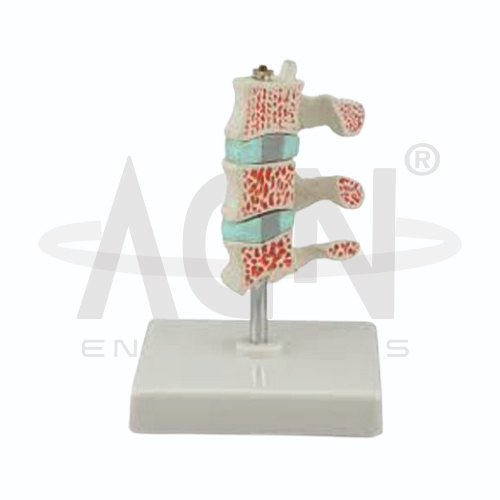
The Advanced Osteoporosis Model from AGN Enterprises is a detailed anatomical and pathological teaching aid designed to demonstrate changes in vertebral bone structure associated with osteoporosis. The model provides an enlarged three-dimensional comparison that helps students understand progressive loss of bone density and changes in internal bone architecture.
It is suitable for medical colleges, nursing institutes, physiotherapy colleges, orthopedic departments, paramedical institutions, anatomy laboratories, pathology departments, and health-science training centers.
The Advanced Osteoporosis Model provides a visual representation of vertebral and cancellous bone structure at different stages or conditions.
Depending on the supplied configuration, represented features may include:
Vertebral Bodies
Intervertebral Discs
Cancellous Bone
Trabecular Bone Structure
Normal Bone Architecture
Reduced Bone Density
Advanced Osteoporotic Changes
Associated Vertebral Changes
The exact stages, structures, and pathological details represented may vary according to the supplied model.
One of the main educational benefits of this model is the ability to compare relatively healthy bone architecture with osteoporotic changes.
Healthy cancellous bone contains an organized network of trabeculae that contributes to structural strength.
With osteoporosis, deterioration of bone microarchitecture and reduction in bone mass can make bones more fragile and susceptible to fractures.
Osteoporosis is a skeletal disorder characterized by reduced bone strength and increased fracture risk.
The model helps demonstrate how changes in bone architecture can affect structural integrity. Its enlarged design makes internal differences easier to visualize during classroom and clinical demonstrations.
The vertebral column is an important site for studying the effects of osteoporosis.
Loss of vertebral bone strength can increase susceptibility to vertebral compression fractures, which may contribute to pain, loss of height, and changes in spinal posture.
The model provides a useful anatomical reference for explaining these concepts.
The internal region of vertebral bodies contains substantial trabecular or cancellous bone.
In osteoporotic bone, trabeculae may become thinner, fewer, and less interconnected. This alteration in internal architecture contributes to reduced mechanical strength.
The model helps students visualize these structural differences in three dimensions.
The Advanced Osteoporosis Model can be used to explain important concepts related to bone health, including:
The model provides students with a three-dimensional approach to studying normal and pathological bone structure.
Teachers can use it for lessons involving osteoporosis, bone density, vertebral anatomy, skeletal pathology, bone remodeling, fracture risk, orthopedics, and musculoskeletal health.
It is particularly useful for connecting normal skeletal anatomy with pathological changes associated with osteoporosis.
AGN Enterprises supplies anatomical models, pathological models, skeletal teaching aids, scientific instruments, and educational laboratory equipment for medical colleges, nursing institutes, physiotherapy programs, paramedical institutions, and professional training centers.
Our teaching models provide clear three-dimensional representations to support anatomy, pathology, and clinical education.