

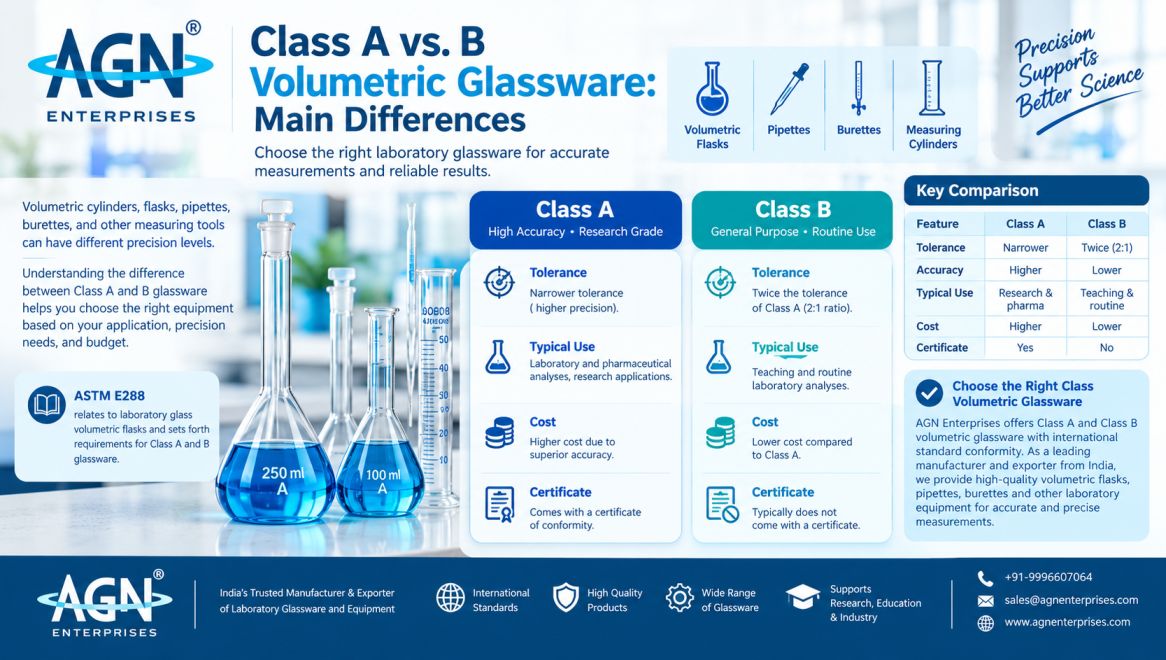
Class A vs. B volumetric glassware – a significant difference should be noted when choosing laboratory glassware and tools for measuring exact volumes of liquids and preparing solution. Volumetric cylinders, flasks, pipettes, burettes, and other measuring tools can have different precision levels. Understanding what is the difference between class A and B glassware is essential in order to choose the right laboratory equipment in accordance with its application, precision level, and cost.
Glassware used in laboratories can be found in various settings, including educational labs, pharma labs, research institutes, and other settings which involve measurement of volumes of liquids. Various standards, including ASTM E288, relate to laboratory glass volumetric flasks and set forth requirements concerning Class A laboratory volumetric glassware, as well as general purpose B class laboratory flasks.
Class A glassware is produced with the highest permissible tolerance (ISO 1042, ASTM E288). This category is used for all volumetric glassware for which a high degree of accuracy and precision is required. In other words, class A volumetric glassware is accurate to the tolerance value indicated on the instrument, making them ideal for laboratory analyses and scientific research. These instruments also typically come with a certificate, and are made from borosilicate glass with low coefficient of expansion.
Class B glassware typically has twice the tolerance of class A instruments. These are secondary measuring devices, which can be used in laboratories where class A glassware is not required, such as teaching laboratories or other similar settings. Generally, class B volumetric glassware is lower in cost compared to class A and is preferred for routine laboratory analysis.
Some of the key differences between the class A and class B volumetric glassware are summarized below:
Tolerance: Class A volumetric glassware typically has the narrower tolerance compared to class B. In particular, class B typically has a tolerance of 2:1 as compared to class A. This also means, that volumetric glassware of class A provides higher accuracy and precision, required for laboratory analyses.
Typical Use: Class A volumetric glassware is employed for laboratory and pharmaceutical analyses, as well as other research applications. Class B, however, is applied in teaching and other routine laboratory analyses.
Cost: Due to higher accuracy, class A volumetric glassware typically costs more than class B.
Certificate: Class A volumetric glassware usually comes with a certificate, whereas class B typically does not.
The tolerances of volumetric glassware are only as good as the manufacturer. As such, a company like AGN Enterprises can offer laboratory glassware and equipment, including volumetric glassware of class A and class B with international standard conformity. Established as a manufacturer and exporter of laboratory glassware and equipment from India, AGN Enterprises provides volumetric glassware in various classes and types. This includes volumetric flasks and other laboratory equipment, constructed from borosilicate glass with low coefficient of expansion.
Volumetric glassware from AGN Enterprises, including volumetric flasks, is produced with highly accurate volume measurement, with conformity to international standards. These volumetric glassware items are subject to stringent in-house conformity testing, prior to being shipped to customers. As a result, whether one needs class A or class B volumetric glassware, AGN Enterprises can provide laboratory equipment with accurate and precise volume measurements, ideal for routine or research laboratory analyses.