



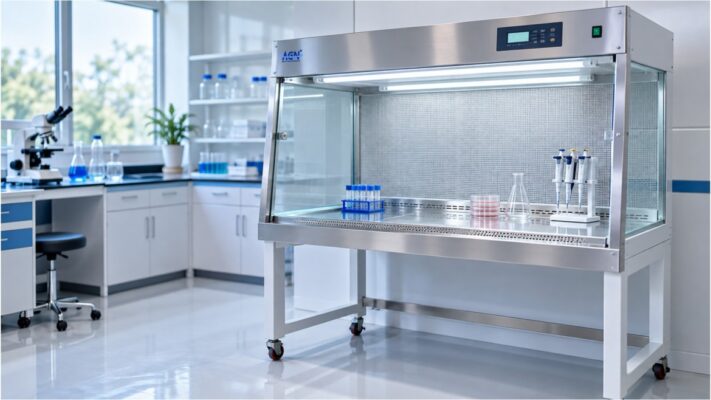
Laminar Air Flow is a laboratory equipment system designed to provide a controlled flow of filtered air across a working area. It is commonly used when samples, materials or processes need protection from airborne particles and contamination. By passing air through filtration and directing it in a controlled, unidirectional pattern, a Laminar Air Flow unit creates a cleaner working environment for sensitive laboratory procedures. Laminar Air Flow systems are used in pharmaceutical laboratories, microbiology, biotechnology, educational laboratories, research facilities and selected industrial applications. Understanding the Laminar Air Flow principle, components, types, applications and limitations helps laboratories select and operate the appropriate system.
Laminar Air Flow refers to the controlled movement of filtered air in a smooth, unidirectional pattern. Instead of allowing air to move randomly around the work area, the system directs filtered air through the chamber in a consistent direction.
A typical Laminar Air Flow unit uses a blower, pre-filtration and a HEPA filtration system. Air is drawn into the cabinet, filtered and then delivered across the working area.
The objective is to reduce the entry and accumulation of airborne particles around materials being handled. This makes Laminar Air Flow useful for applications where product or sample cleanliness is important.
It is important to understand that a Laminar Air Flow cabinet is primarily intended to provide clean air and product protection. It should not automatically be considered a replacement for a biosafety cabinet or other containment equipment when hazardous biological or chemical materials are involved.
The Laminar Air Flow principle is based on moving filtered air in a controlled, unidirectional stream with minimal turbulence.
The basic process is:
Room Air → Pre-Filter → Blower → HEPA Filter → Clean Air → Working Area
First, surrounding air enters the unit. A pre-filter removes larger airborne particles before the air reaches the main filtration stage. The blower then moves the air through the HEPA filter.
After filtration, the air is distributed uniformly across the working area. The continuous airflow helps reduce the opportunity for airborne particles to settle on exposed materials.
The exact airflow arrangement depends on whether the cabinet is designed as a horizontal or vertical Laminar Air Flow system.

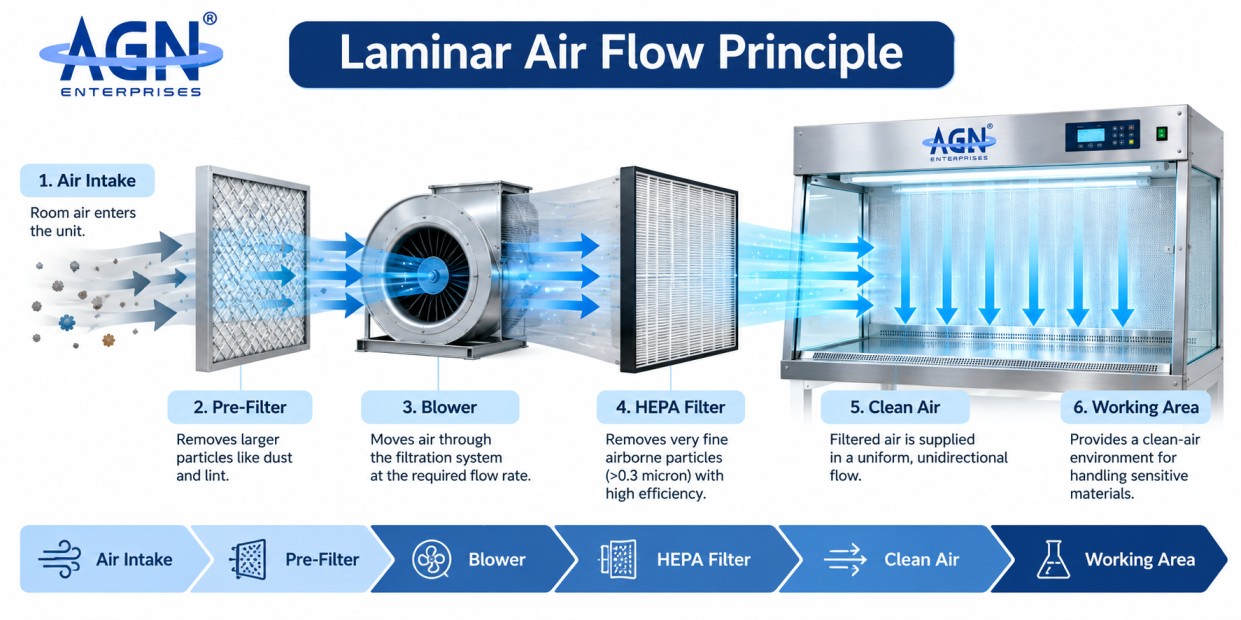
A Laminar Air Flow unit generally operates through the following stages:
Air from the surrounding environment enters the cabinet through the designated air intake.
The incoming air passes through a pre-filter that captures larger particles such as dust and lint. This helps reduce the load on the HEPA filter.
A blower or fan moves the air through the filtration system at the required airflow rate.
The air passes through the HEPA filtration stage, where very fine airborne particulate matter is removed according to the filter’s specified efficiency.
The filtered air is then supplied to the work area in a controlled direction.
The resulting airflow provides a cleaner working environment for applications where airborne contamination needs to be minimized.
Proper operation also requires appropriate cleaning, loading practices and maintenance. A cabinet cannot compensate for poor laboratory practices or an application for which the equipment is unsuitable.
A basic Laminar Air Flow diagram can be used to understand the movement of air through the equipment.
Air Inlet → Pre-Filter → Blower → HEPA Filter → Filtered Air → Working Area
For a horizontal Laminar Air Flow, filtered air generally moves:
Rear → Front
For a vertical Laminar Air Flow, filtered air generally moves:
Top → Bottom
A properly labelled diagram should identify the blower, pre-filter, HEPA filter, work surface and airflow direction. Such a diagram is particularly useful for students, laboratory personnel and buyers comparing different cabinet configurations.
A Laminar Air Flow cabinet consists of several components that work together to provide controlled airflow.

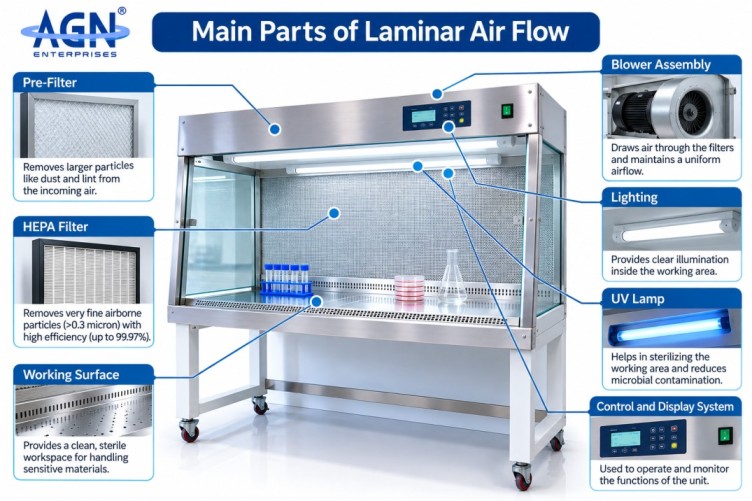
The cabinet forms the main structure of the equipment and contains the working zone, filtration system and airflow components.
The pre-filter captures relatively larger airborne particles before air reaches the HEPA filter. Regular inspection and replacement are important for maintaining airflow performance.
The HEPA filter is the primary high-efficiency filtration component. Its performance specification should be considered carefully when selecting a Laminar Air Flow system.
The blower draws and moves air through the filtration system and helps maintain the required airflow across the working area.
The working surface provides a cleanable area for placing laboratory materials, samples and instruments.
Integrated illumination allows users to clearly see the work surface during laboratory procedures.
Some Laminar Air Flow models include a UV lamp for pre-use surface treatment. UV systems must be operated according to manufacturer instructions and appropriate safety precautions.
Depending on the model, the control system may provide information such as airflow, temperature, UV operating time and filter-related information.
The two commonly discussed configurations are:
Both designs provide controlled filtered airflow, but the direction of airflow and cabinet configuration are different.

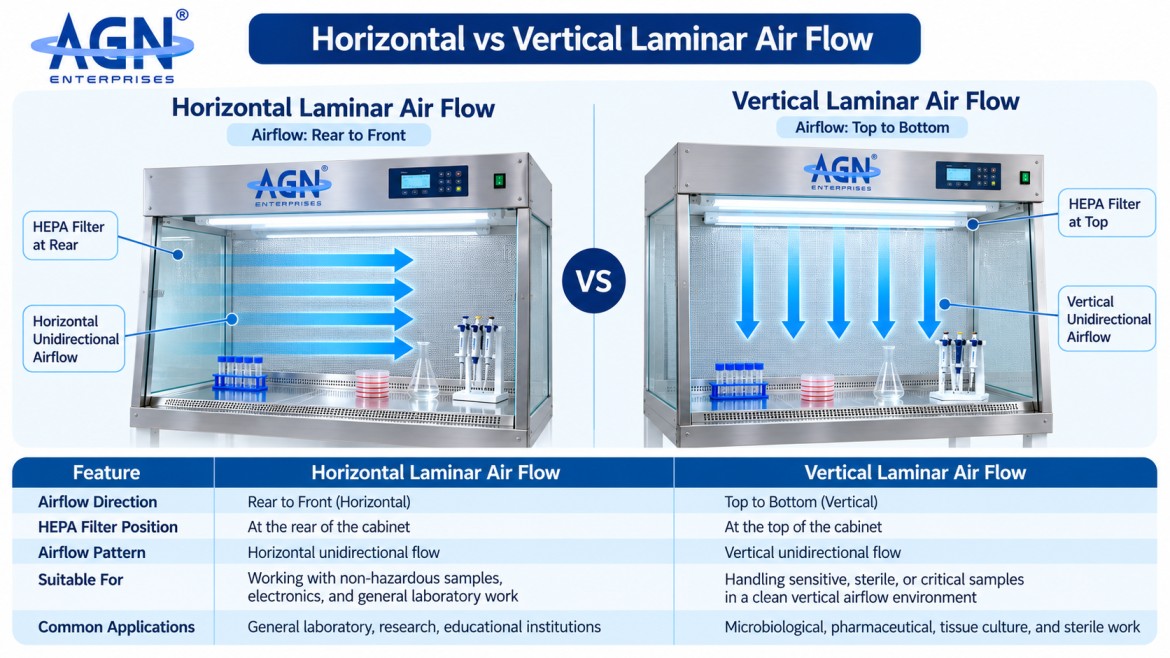
In a horizontal Laminar Air Flow cabinet, filtered air generally travels from the rear of the cabinet toward the front.
The HEPA filtration stage is positioned toward the rear, and filtered air travels across the working surface.
Horizontal systems can be used for applications where clean airflow and product protection are important, including selected:
Because airflow can move toward the operator, the application should be assessed carefully before selecting this configuration. It is not intended to provide personnel protection from hazardous materials.
In a vertical Laminar Air Flow cabinet, filtered air travels downward toward the working area.
This configuration can be useful where the downward airflow pattern suits the laboratory workflow and available space.
Vertical systems may be used for selected:
The appropriate configuration should always be selected according to the actual application and contamination-control requirements.
| Feature | Horizontal Laminar Air Flow | Vertical Laminar Air Flow |
|---|---|---|
| Airflow direction | Rear to front | Top to bottom |
| Typical filter position | Rear section | Upper section |
| Airflow path | Across the work surface | Downward toward the work area |
| Common consideration | Direct airflow toward front | Downward airflow configuration |
| Suitable applications | Product and precision work | Selected laboratory and pharmaceutical applications |
| Selection factor | Workflow and available space | Workflow and available space |
Neither configuration should be selected simply because it is labelled horizontal or vertical. The correct choice depends on the materials, procedure, available space and level of protection required.
Laminar Air Flow is used in a variety of laboratory and industrial environments where minimizing airborne contamination is important.
Laminar Air Flow can support selected pharmaceutical laboratory activities requiring a controlled clean-air working environment.
It can be used for appropriate microbiological procedures where product or sample protection from environmental contamination is required.
Research and biotechnology applications may use Laminar Air Flow systems for suitable clean handling procedures.
Schools, colleges, universities and training laboratories can use Laminar Air Flow equipment for teaching laboratory practices involving contamination control.
Clean-air workstations can also be useful in applications where dust and airborne particles can affect sensitive components.
Research laboratories may use Laminar Air Flow systems for controlled handling and preparation of materials where a cleaner working environment is required.
Laminar Air Flow and biosafety cabinets should not be treated as interchangeable equipment.
| Feature | Laminar Air Flow | Biosafety Cabinet |
|---|---|---|
| Main purpose | Clean-air/product protection | Specified biological containment |
| Airflow design | Unidirectional clean airflow | Controlled containment airflow |
| Product protection | Yes, depending on configuration | Yes |
| Personnel protection | Not the primary purpose | Depends on cabinet class |
| Hazardous biological work | Not a substitute for appropriate containment | Designed for specified containment applications |
| Selection | Based on clean-air requirements | Based on biological risk and containment requirements |
The correct equipment should therefore be selected according to the risk assessment and application rather than simply the appearance of the cabinet.
A properly selected and maintained Laminar Air Flow system can offer several advantages:
Its effectiveness depends on proper installation, operation, maintenance and suitability for the intended application.
Laminar Air Flow also has important limitations.
It should not be assumed to provide protection against every biological, chemical or hazardous material. In particular, applications involving hazardous biological agents may require an appropriately classified biosafety cabinet.
The cabinet should also not be overloaded. Excessive materials, unnecessary movement and blocked airflow paths can interfere with the intended airflow pattern.
Regular cleaning, filter inspection, airflow verification and servicing are important for maintaining performance.
Before purchasing a Laminar Air Flow system, consider the following factors:
Determine exactly what materials and procedures will be handled inside the cabinet.
Choose between horizontal and vertical airflow according to the application and workflow.
Select a cabinet with sufficient working space without unnecessarily restricting laboratory space.
Check the HEPA filter specification and filtration performance offered by the manufacturer.
For applications requiring controlled airflow, consider systems with suitable airflow monitoring and display features.
A smooth, durable and easy-to-clean working surface is important for laboratory use.
Adequate illumination improves visibility during laboratory procedures.
Depending on requirements, features such as digital displays, airflow monitoring, temperature indication and UV operating-hour monitoring may be useful.
Consider filter replacement, servicing requirements, warranty and technical support before purchasing.

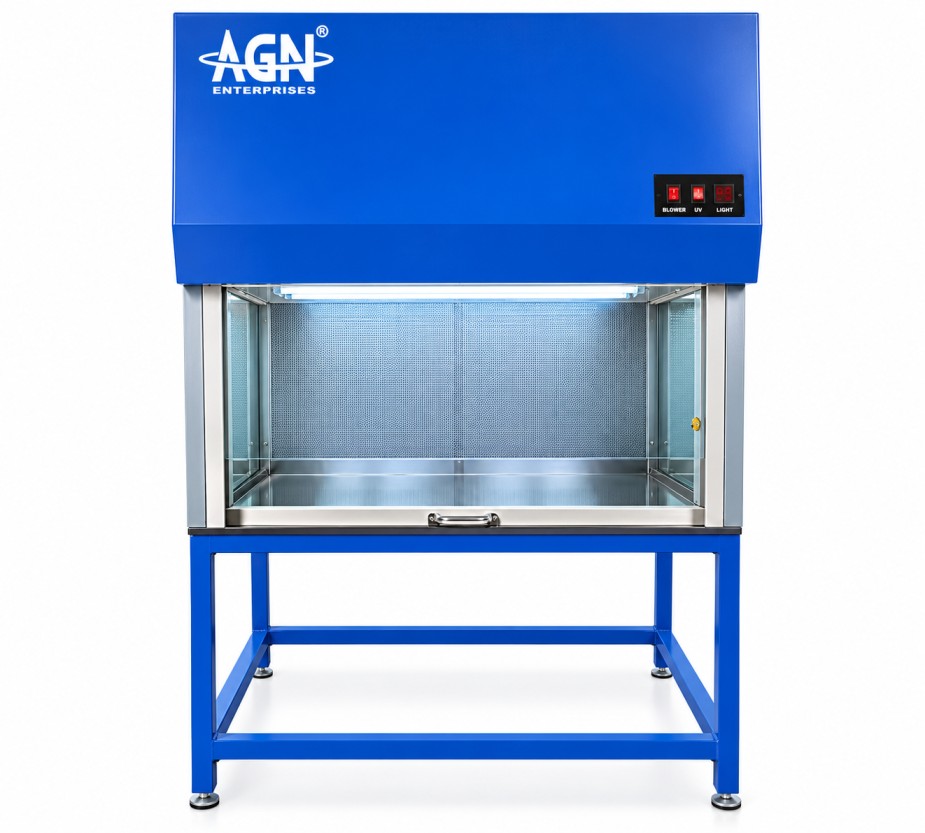
AGN Enterprises offers Laminar Air Flow equipment for laboratory and pharmaceutical applications.
The AGN-159 Horizontal Laminar Air Flow is a microprocessor-controlled cabinet with an LCD display. The listed configuration has a 4 ft × 2 ft × 2 ft working size and includes two high-efficiency HEPA filters specified at 99.999% efficiency for particles greater than 0.3 micron, along with pre-filters.
The listed system also includes a UV tube rated at 254 nm, fluorescent illumination, an inbuilt blower assembly, gas/vacuum cock, door-open alarm and LCD monitoring functions. The display can show airflow pressure, Laminar Air Flow velocity, cabinet temperature, UV operating hours and HEPA filter change information.
For buyers evaluating a Laminar Air Flow system, the appropriate configuration should be selected according to the intended laboratory application, available space and required technical specifications.
Routine maintenance is essential for reliable operation.
Clean the working surface using an appropriate laboratory cleaning or disinfecting procedure before and after use.
Pre-filters and HEPA filters should be inspected and serviced or replaced according to the manufacturer’s recommendations and operating conditions.
Airflow performance should be checked periodically using appropriate measurement and verification procedures.
The blower and motor assembly should be inspected as part of scheduled servicing.
If the cabinet has a UV lamp, monitor its operating hours and follow the manufacturer’s instructions for safe use.
Do not unnecessarily obstruct the airflow path with excessive equipment, containers or materials.
Laminar Air Flow is a controlled clean-air system that directs filtered air in a uniform, unidirectional pattern across a working area.
The Laminar Air Flow principle involves passing air through filtration and delivering it in a controlled, relatively uniform direction to reduce airborne contamination in the working area.
The commonly used configurations are horizontal and vertical Laminar Air Flow systems.
Horizontal Laminar Air Flow directs filtered air from the rear of the cabinet toward the front across the working surface.
Vertical Laminar Air Flow directs filtered air downward from the upper filtration section toward the working area.
Laminar Air Flow is used for suitable laboratory, pharmaceutical, research, educational and precision-work applications where protection from airborne contamination is important.
HEPA filtration is commonly used as the main high-efficiency filtration stage. The exact filter specification should be checked against the manufacturer’s product documentation.
No. Laminar Air Flow is primarily intended for clean-air/product protection, while biosafety cabinets are designed for specified containment applications.
There is no universal replacement interval. Filter condition and replacement requirements depend on the equipment, operating environment, usage and manufacturer’s recommendations.
When selecting a Laminar Air Flow, consider the application, airflow direction, working area, HEPA filtration specification, monitoring features, construction, maintenance requirements and available laboratory space. AGN Enterprises offers Laminar Air Flow systems designed for different laboratory and pharmaceutical requirements, allowing buyers to consider suitable configurations based on their specific application and workspace.
For laboratories looking for a reliable Laminar Air Flow system, AGN Enterprises provides laboratory equipment with application-focused configurations and technical specifications. Buyers can review factors such as cabinet size, filtration, airflow configuration and monitoring features before selecting the appropriate system.
Laminar Air Flow provides a controlled clean-air environment for applications where minimizing airborne contamination is important. Its operation combines air movement, pre-filtration, HEPA filtration and controlled airflow to create a suitable working environment for selected laboratory procedures.
Understanding the Laminar Air Flow principle, types, working, components, applications and maintenance requirements can help laboratories make a more informed equipment selection.
Whether you are looking for a horizontal Laminar Air Flow, vertical Laminar Air Flow, Laminar Air Flow cabinet or laboratory clean-air workstation, the equipment should always be selected according to the specific application and required level of protection.
AGN Enterprises provides laboratory and pharmaceutical equipment, including Laminar Air Flow systems, with configurations and technical specifications designed for laboratory requirements.